
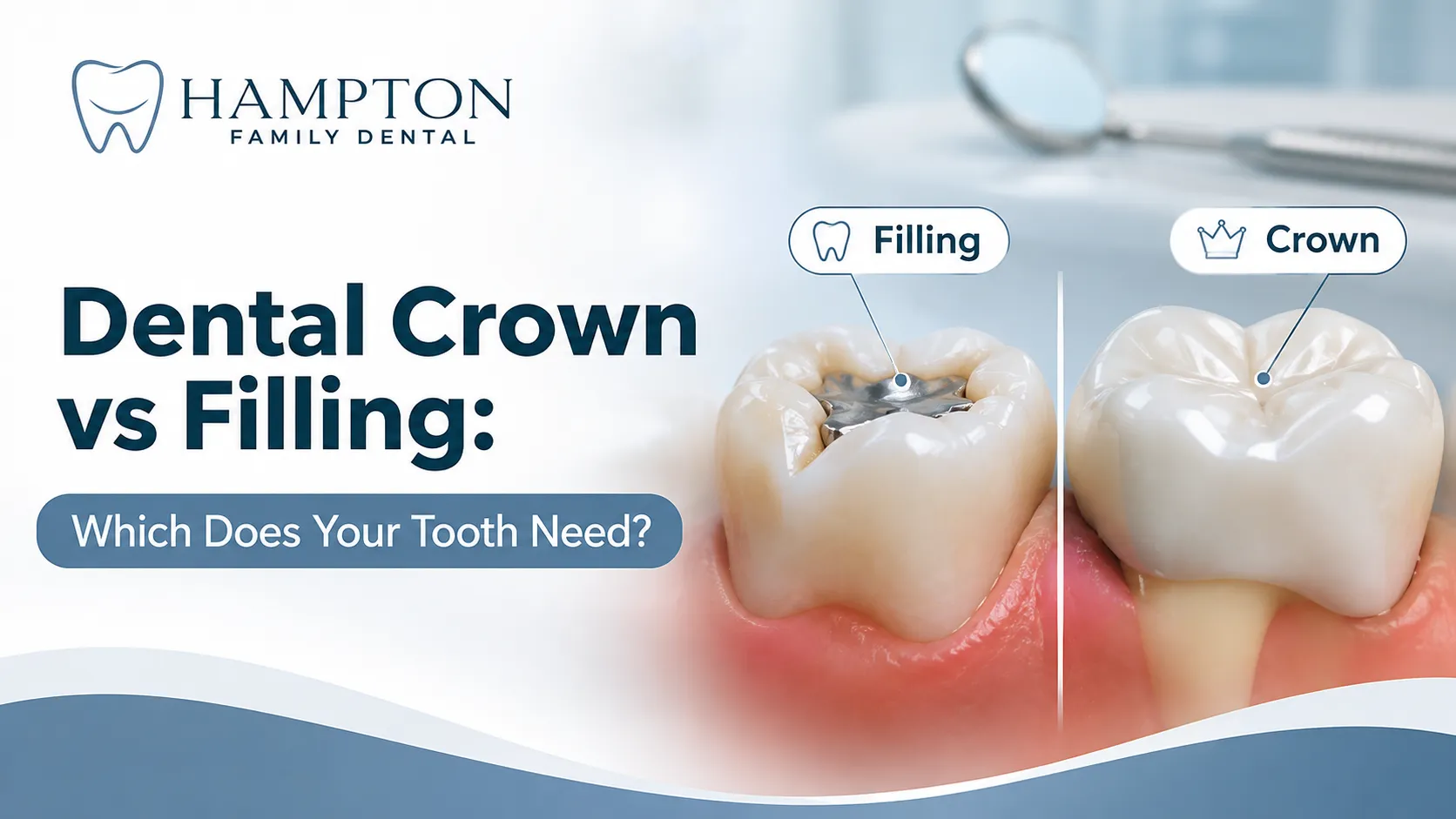
A filling repairs a tooth that's still mostly intact. A crown covers a tooth that has lost too much structure to hold a filling safely. The deciding factor isn't the size of the cavity — it's how much healthy tooth is left once the decay is removed. At Hampton Family Dental in Southampton, PA, Dr. Jeffrey Brenner uses an exam and X-ray to make that call, and there's a middle option between the two that most people have never heard of.
The short version
- What decides it is how much healthy tooth remains after the decay is cleaned out — not how big the cavity looked on the X-ray.
- There's a third option. Inlays and onlays sit between a filling and a crown, and most comparison articles skip them entirely.
- Cost per tooth without insurance: filling $100–$450, inlay or onlay $650–$1,200, crown $1,000–$2,500.
- A crown on a tooth that only needed a filling removes healthy structure you can't get back. The right answer is the most conservative option that will actually hold.
- If a crown is recommended and you're unsure, ask to see the X-ray and ask whether an onlay would work. A dentist confident in the recommendation won't mind the question.
Crown vs filling at a glance
| Filling | Inlay / onlay | Crown | |
|---|---|---|---|
| What it covers | Inside the cavity only | Inside the cusps, or over one or more of them | The entire visible tooth |
| Healthy tooth removed | Least | Moderate | Most |
| Visits | One | Usually two | Usually two (sometimes one) |
| Typical cost | $100–$450 | $650–$1,200 | $1,000–$2,500 |
| Typical lifespan | 5–15 years | 10–20 years | 10–30 years |
| Best for | A tooth that's still mostly intact | A tooth too damaged for a filling but not yet needing a crown | A tooth that can't support a filling, or is cracked |
| Available at Hampton Family Dental | Yes | Yes | Yes |
What a filling actually does
A filling replaces the part of the tooth that decay destroyed. The dentist removes the decayed tissue, cleans the cavity, and packs the space with a material that bonds to or sits within the remaining tooth. Dental fillings at Hampton Family Dental are usually done in a single visit.
The two common materials, per ADA MouthHealthy:
- Composite resin — tooth-coloured, bonds to the tooth, typically lasts 5 to 10 years. The usual choice for visible teeth.
- Amalgam — silver-coloured, very durable under heavy chewing force, typically lasts 10 to 15 years. Still used on back teeth where strength matters more than appearance.
The limitation is structural. A filling fills a hole; it doesn't hold the tooth together. The surrounding walls of the tooth still do that work. Once those walls get thin enough, a filling can act like a wedge every time you bite, and the tooth cracks around it.
What a crown actually does
A crown is a cap that covers the whole visible tooth. The dentist reshapes what remains, takes an impression or digital scan, and fits a custom-made cover over it. See dental crowns at Hampton Family Dental for the full process, or ADA MouthHealthy for the general overview.
The point of a crown is the opposite of a filling. Instead of filling a hole, it wraps the tooth and holds it together, so chewing force is carried by the crown rather than by weakened tooth walls. That's why crowns are the answer for cracked teeth and heavily rebuilt teeth.
The trade-off: fitting a crown means removing healthy tooth structure all the way around, and you don't get that back. A crown is the right call when the tooth genuinely needs it and an unnecessary loss when it doesn't. That's the whole reason this decision matters.
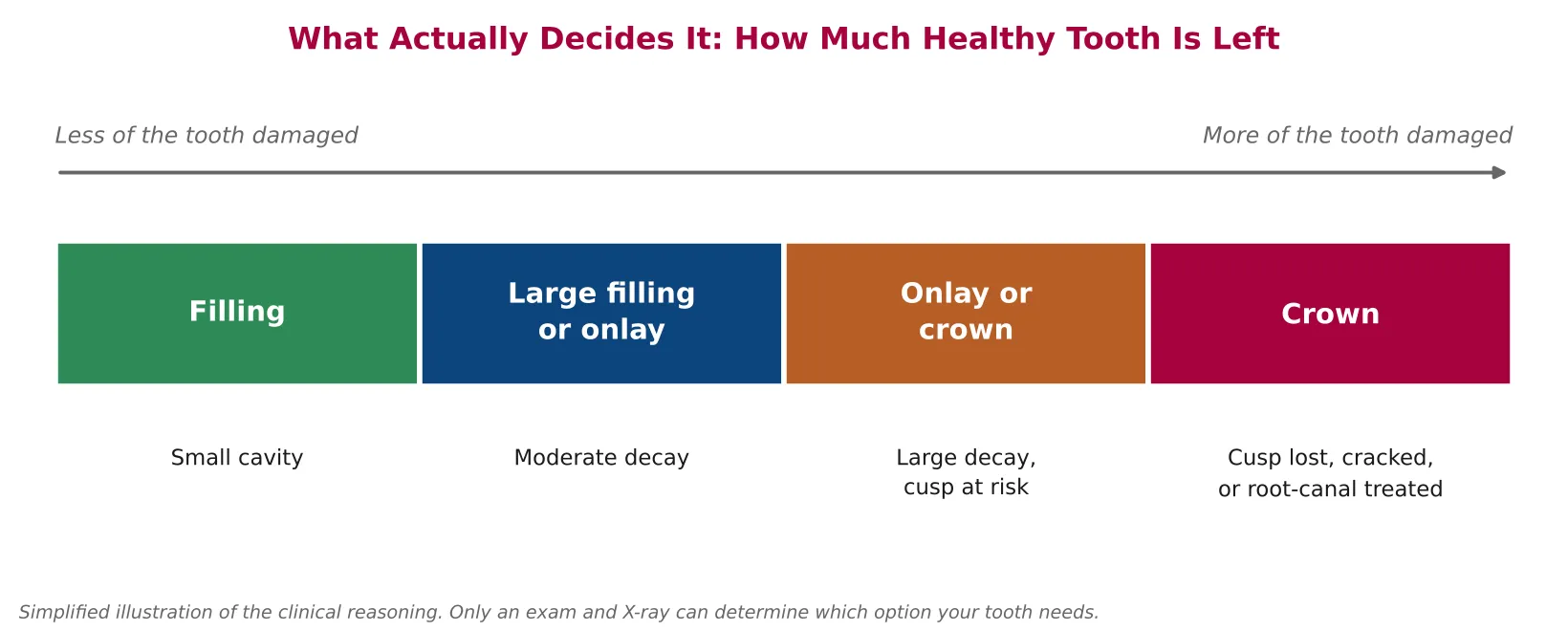
What decides it: how much healthy tooth is left
Here's the part most articles leave out. The decision isn't made from the cavity you can see — it's made after the decay is removed, when the dentist can see how much solid tooth is actually left. Per Cleveland Clinic, full coverage is indicated when a tooth is too weak or too broken down to be restored any other way.
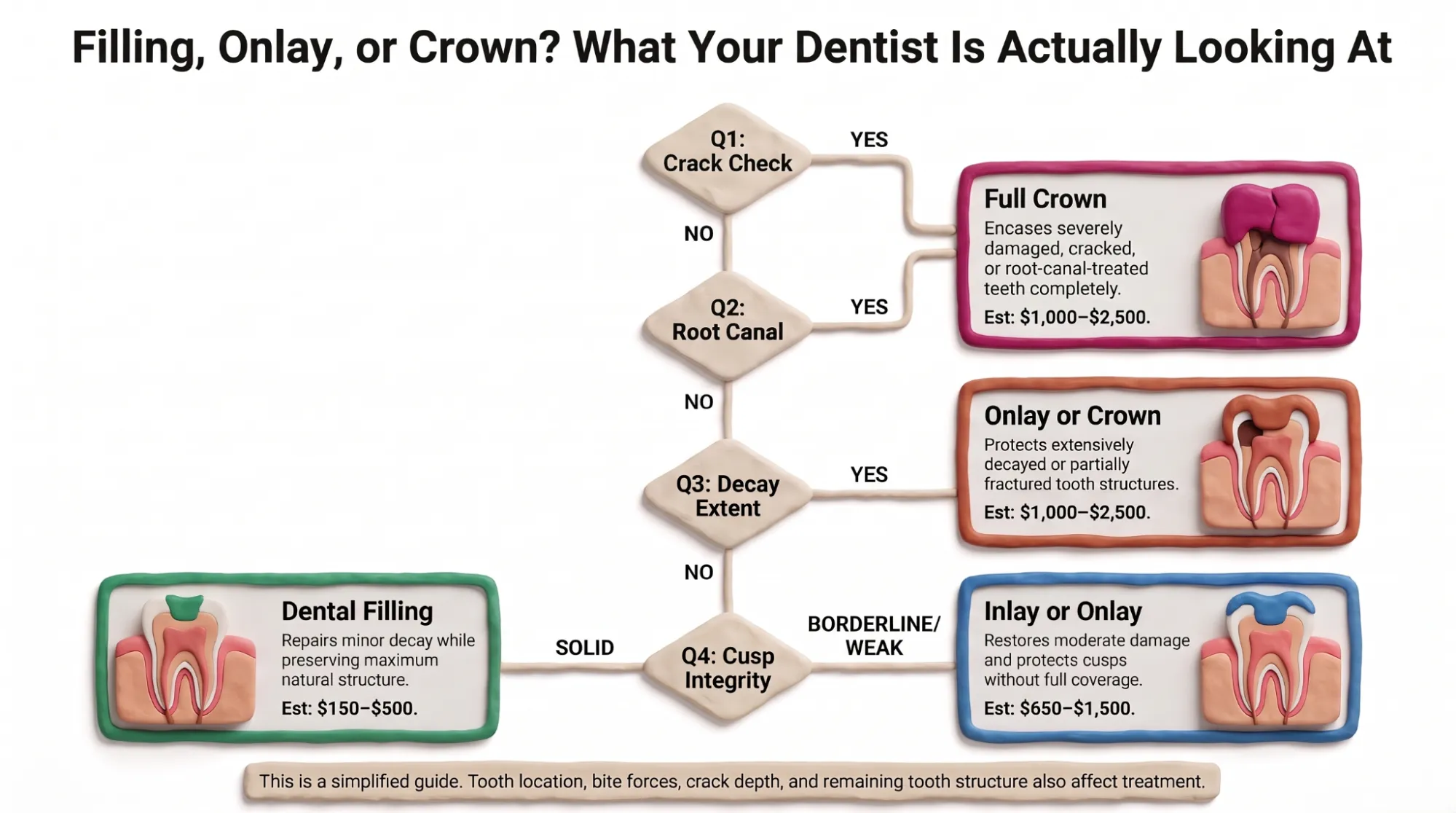
The practical criteria a dentist weighs:
- How much of the tooth's width the damage covers. Roughly past the halfway mark, the remaining walls get too thin to trust.
- Whether any cusp — the raised points on the chewing surface — is broken or undermined. An undermined cusp will eventually snap off.
- Whether there's a crack, and how far it runs.
- How much force the tooth takes. Back molars do the heavy chewing and are less forgiving than front teeth.
- Whether you grind your teeth, which multiplies the load on whatever is placed.
There's a third option: inlays and onlays
Crown-versus-filling is a false choice for a lot of teeth. There's a middle category, and it's underused:
- An inlay is a lab-made or milled piece that fits inside the cusps, like a very precise filling made outside the mouth.
- An onlay covers one or more cusps as well, without wrapping the entire tooth.
Why it matters: an onlay protects a weakened cusp the way a crown does, but removes noticeably less healthy tooth. For a tooth that's too far gone for a filling but doesn't yet need full coverage, it's often the better answer — stronger than a large filling, more conservative than a crown, and usually somewhere between the two on cost.
If a crown has been recommended, "would an onlay work here?" is a completely fair question to ask.
When a filling is never enough
Some situations rule out a filling regardless of cavity size.
A cracked tooth
A crack moves under pressure. Every bite flexes the two halves slightly apart, which is why cracked teeth often hurt on release rather than on biting down. A filling placed into a crack doesn't stop that movement and can make it worse. A crown protects the remaining tooth by holding it together so the crack can't propagate.
After a root canal
A tooth that's had root canal treatment has been hollowed out and is more brittle than it was. Back teeth in particular are usually crowned afterwards, because the chewing load on an unprotected root-treated molar tends to split it. If you're weighing the overall cost of that pathway, here's what a root canal costs.
A large old filling that's failing
This is the most common real-world version. A big amalgam placed twenty years ago leaves thin surrounding walls, and over time those walls flex, leak at the margins, or fracture. Replacing it with another large filling usually buys a few years at best. If an old filling is cracking at the edges or feeling sensitive, it's worth having the tooth checked before it gets worse — the options are better while the cusps are still intact.
How much does each one cost?
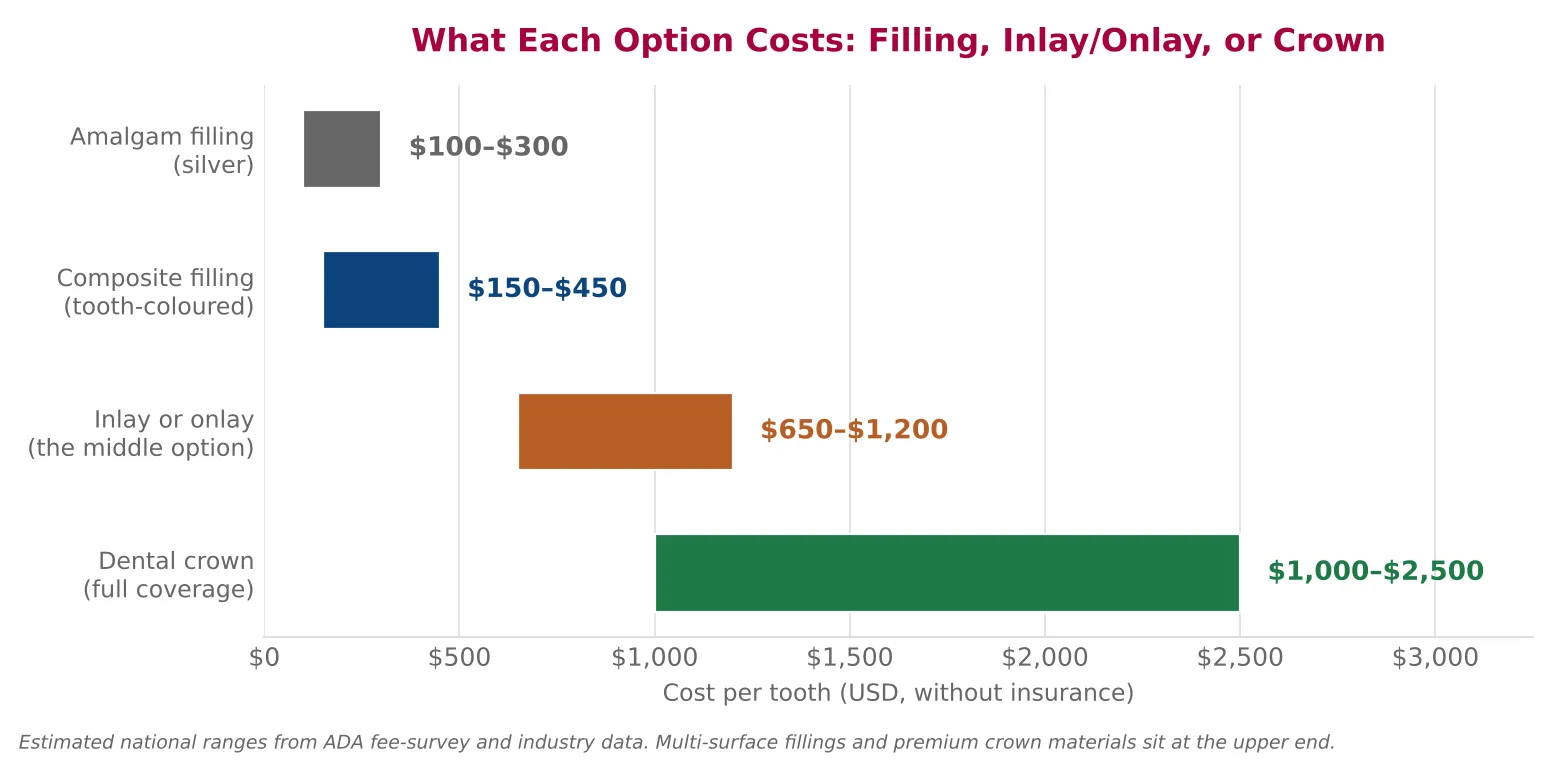
Side by side, without insurance:
| Option | Typical cost per tooth | Visits |
|---|---|---|
| Amalgam filling | $100–$300 | One |
| Composite filling | $150–$450 | One |
| Inlay or onlay | $650–$1,200 | Usually two |
| Crown | $1,000–$2,500 | Usually two |
For the full picture on crown pricing specifically — materials, lab fees, and what drives the range — see what a dental crown costs in detail.
Insurance: most dental plans cover both fillings and crowns, usually at different percentages, and crowns more often carry waiting periods or frequency limits. We'll verify your benefits before treatment so you know your out-of-pocket cost in advance. If you're uninsured, our membership plan starts at $288 a year and includes 15% off restorative procedures.
Which one lasts longer?
Crowns last longest, but the gap matters less than the arithmetic behind it.
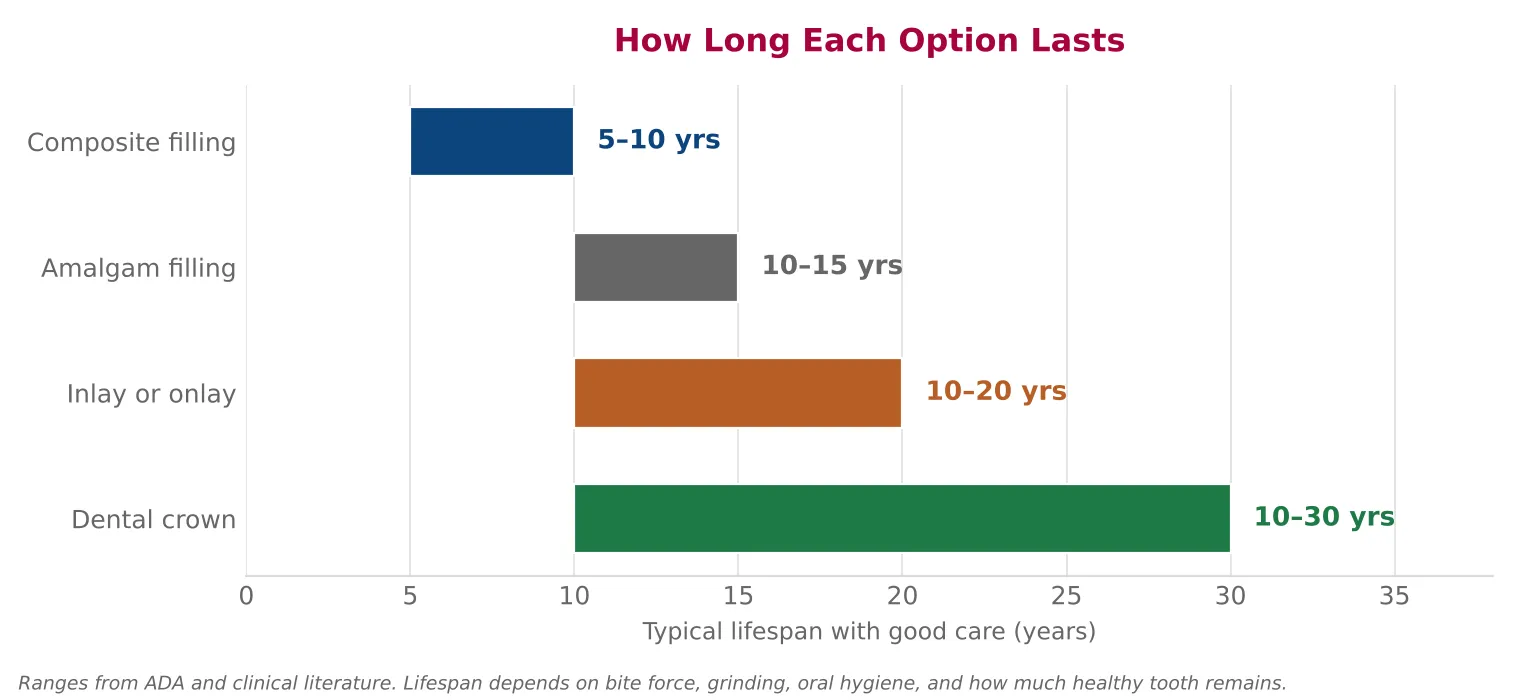
Here's the part worth thinking about. If a tooth is borderline and a large filling is likely to fail within a few years, the sequence becomes: pay for the filling, then pay for the crown anyway when it fails — and possibly for a root canal in between if the failure cracks the tooth. That total exceeds the crown on its own.
It cuts the other way too. If the tooth is genuinely sound enough for a filling, a crown costs several times more and removes healthy structure for nothing. Neither option is automatically the economical one — it depends entirely on how likely the filling is to hold, which is a judgement made at the exam.
Why did my dentist recommend a crown?
Let's address the question underneath this one, because a lot of people are thinking it and not asking: am I being upsold?
It's a reasonable thing to wonder. A crown costs several times what a filling costs. So here are the legitimate reasons a crown gets recommended:
- Too little solid tooth remained once the decay came out
- A cusp is cracked, undermined, or already broken
- A large existing filling is failing and can't be reliably replaced
- The tooth has had a root canal
- There's a visible crack line
And here's what to ask if you're unsure:
- "Can you show me the X-ray and point out what you're seeing?"
- "Roughly how much of the tooth is affected?"
- "Would an onlay work instead of a full crown?"
- "What happens if we try a filling first?"
- "What's the risk if I wait six months?"
Any dentist confident in the recommendation will answer all five without hesitation and show you the image. If the answers feel evasive, a second opinion is a perfectly normal thing to get — most dentists would rather you were sure. If you want the pricing side laid out first, our full breakdown of crown pricing covers it.
Request a dental evaluation
See the X-ray, hear the reasoning, and get a written estimate for your tooth before anything begins.
How your Southampton dentist makes the call
Dr. Jeffrey Brenner, DMD has practised in Southampton for over twenty years and places fillings, onlays and crowns. Here's the sequence at an evaluation:
- Step 1 — Exam and X-ray. The X-ray shows how deep the decay runs and whether it's near the nerve. The visual exam checks the cusps and looks for crack lines.
- Step 2 — Remove the decay. This is the moment the real answer appears. Decay is frequently larger underneath than it looks on the surface, which is why a plan occasionally changes mid-appointment.
- Step 3 — Assess what's left. How much solid structure remains, whether the cusps are sound, whether the walls will take chewing force.
- Step 4 — Choose the most conservative option that will hold. Filling if the tooth can support one. Onlay if a cusp needs protecting but the tooth doesn't need wrapping. Crown if it does.
- Step 5 — Explain it and price it before anything starts. You see the X-ray, you hear the reasoning, and you get a written estimate. Restorative dentistry services at Hampton Family Dental cover the full range, so the recommendation is driven by the tooth rather than by what's available.
The short version
If your tooth is mostly intact, a filling is the right answer and a crown would be more than it needs. If a cusp is cracked or most of the tooth is gone, a filling won't hold and a crown is the honest recommendation. Plenty of teeth sit in between, and that's what onlays are for. An exam with an X-ray is the only way to know which one you're dealing with — and you should expect to see the image and hear the reasoning before you agree to anything. Hampton Family Dental is on Second Street Pike in Southampton, PA.
Get a cost estimate for your tooth
Request a dental evaluation. We'll show you the X-ray, explain whether a filling, onlay, or crown fits, and price it before anything starts.