
Teeth grinding, or bruxism, is treated two ways at once: a custom night guard protects your teeth from the force, and separate work addresses what's causing it — usually stress, disrupted sleep, or a bite problem. A guard does not stop the grinding; it stops the damage. At Hampton Family Dental in Southampton, PA, Dr. Jeffrey Brenner checks for grinding at every exam.
The short version
- A night guard protects your teeth. It does not stop the grinding and it does not repair damage already done.
- Most people who grind don't know it. The clearest signs — wear facets, hairline cracks — are only visible at a dental exam.
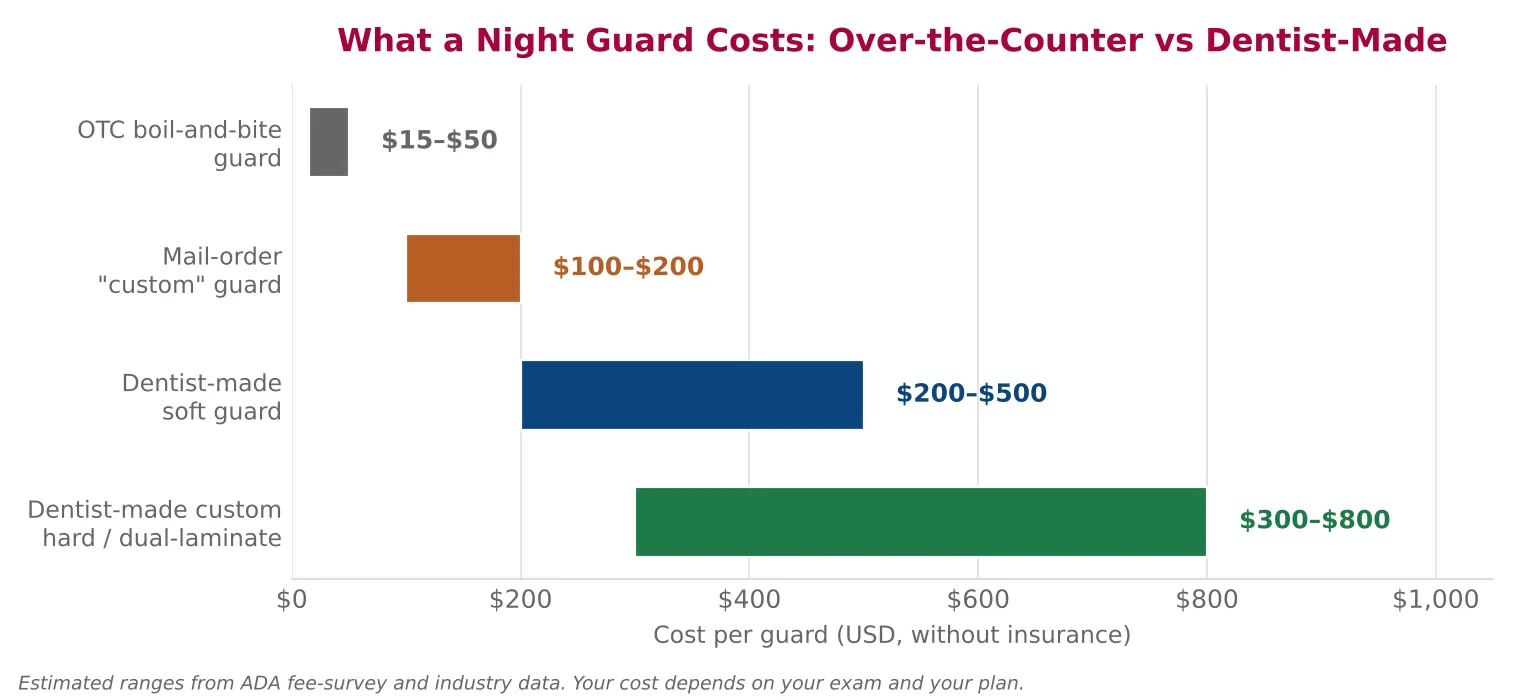
- A dentist-made custom guard typically costs $300–$800. An over-the-counter guard costs $15–$50 and is a reasonable short-term stopgap, not a long-term answer.
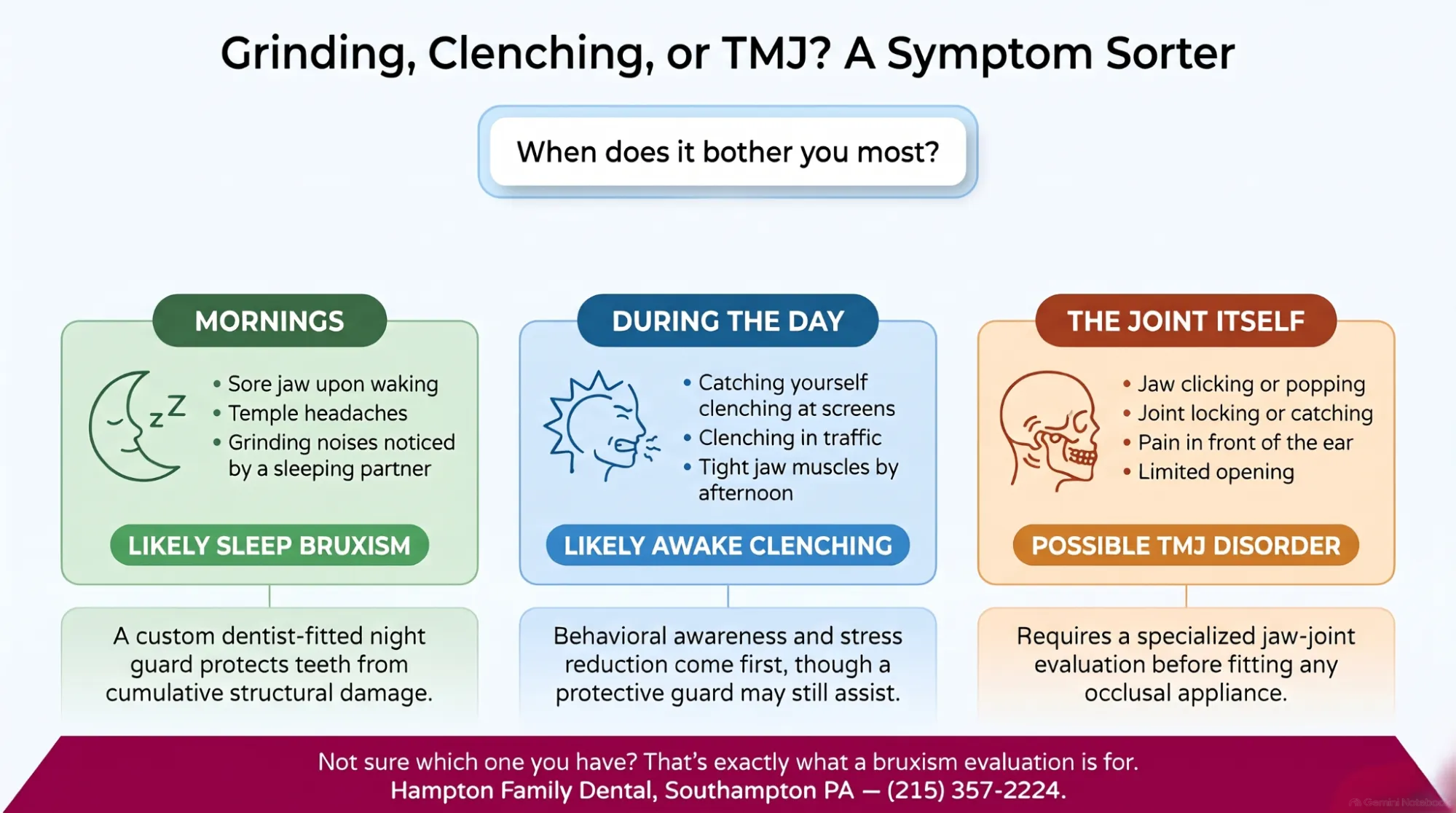
- Bruxism and TMJ disorder are not the same thing. Bruxism is the behaviour; TMD is a problem with the joint. One can cause the other.
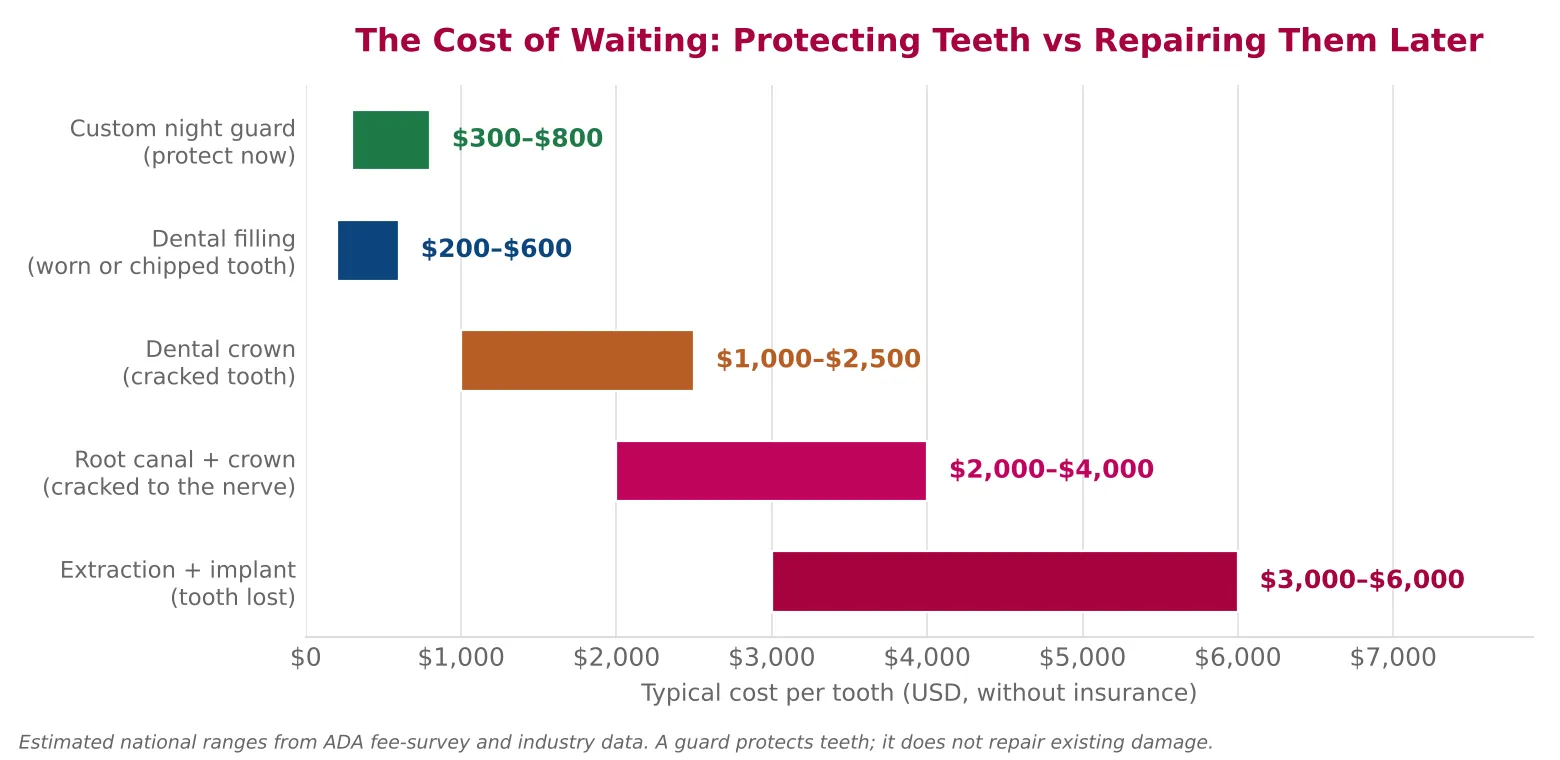
- Untreated grinding gets expensive. A $300–$800 guard protects against repairs that run $1,000–$2,500 per crown and more if a tooth is lost.
What is bruxism?
Bruxism is the medical term for grinding, gnashing, or clenching your teeth. According to ADA MouthHealthy, it affects both adults and children, and many people have no idea they do it.
There are two kinds, and they behave differently:
- Sleep bruxism happens while you're unconscious. You can't catch yourself doing it, the forces involved are much higher than normal chewing, and usually a partner hears it before you notice anything.
- Awake bruxism is usually clenching rather than grinding — the jaw-tightening you do at a screen, in traffic, or during a hard conversation. This one you can learn to catch.
The distinction matters because the treatment is different. Sleep bruxism needs physical protection, because you can't modify a behaviour you're not awake for. Awake clenching responds to awareness and habit work.
What causes teeth grinding?
There's rarely one cause. Mayo Clinic groups the contributing factors like this:
| Factor | How it contributes |
|---|---|
| Stress and anxiety | The most commonly reported trigger for both sleep and awake bruxism. Tends to flare during difficult periods. |
| Disrupted sleep | Sleep bruxism often clusters with other sleep disturbances, including snoring and pauses in breathing. |
| Caffeine, alcohol, tobacco | All three are associated with more grinding, especially in the hours before bed. |
| Certain medications | Some antidepressants and stimulants list bruxism as a side effect. Never stop a prescription on your own — raise it with the prescribing doctor. |
| Bite problems | Teeth that don't meet evenly can contribute, though this is less often the sole cause than people assume. |
| Age | Sleep bruxism is common in children and often decreases into adulthood. |
Is it just stress? Often it's the main driver — but not always, and assuming it is can mean missing a sleep or medication factor that would have been straightforward to address. That's one reason the exam matters.
Signs you may be grinding your teeth
Signs you can notice yourself
- Waking with a sore, tired, or tight jaw
- A dull headache around the temples, usually in the morning
- Teeth that feel sensitive to hot, cold, or sweet
- Front teeth that look flatter or shorter than they used to
- A partner who hears grinding at night
- Ridged or scalloped edges along the sides of your tongue
- A pale raised line along the inside of your cheek, level with your bite
- Aching that spreads into the ear or the side of the face
Signs only a dentist can see
This is the part you can't self-check, and it's usually the part that confirms it. At a routine checkup and X-rays appointment, a dentist looks for:
- Wear facets — flat, polished patches where opposing teeth have ground against each other
- Hairline cracks in the enamel that aren't visible in a mirror
- Enlarged jaw muscles, felt by hand along the side of the face
- Gum recession and notching at the gumline, which can overlap with signs of gum disease
- Fillings, crowns, or veneers that are failing earlier than they should
- Changes in wear patterns compared with previous records — the clearest evidence of all
None of these are things you can diagnose from a mirror or a photo online. If several of the self-check signs sound familiar, an exam is the way to find out.
Is it teeth grinding or TMJ?
These get used interchangeably and they shouldn't be. Bruxism is the behaviour — the grinding or clenching. TMJ disorder (properly, TMD) is a problem with the temporomandibular joint itself, the hinge in front of your ear. Per NIDCR, TMD covers a range of conditions affecting the joint, the muscles around it, or both.
| Bruxism | TMJ disorder (TMD) | |
|---|---|---|
| What it is | A behaviour — grinding or clenching | A condition of the jaw joint or its muscles |
| Where you feel it | Teeth, jaw muscles, temples | The joint itself, in front of the ear |
| Typical signs | Worn teeth, morning soreness, headaches | Clicking, popping, locking, limited opening |
| When it's worst | On waking (sleep type) or under stress (awake type) | When chewing, yawning, or opening wide |
| First-line approach | Protect the teeth, address the cause | Evaluate the joint before anything else |
They overlap constantly. Sustained grinding can overload the joint and lead to TMD; an uncomfortable joint can change how you hold your jaw and encourage clenching. Plenty of patients have both — which is exactly why a guard alone isn't always the right answer. If your jaw clicks, catches, or locks, that needs evaluating before anyone fits you for anything.
What happens if you don't treat it?
Grinding is cumulative. A single night does nothing. Years of it does a great deal, and the damage follows a fairly predictable sequence:
- Enamel wears down, teeth shorten and flatten, and sensitivity increases as the dentine underneath is exposed.
- Existing dental work starts failing early — fillings, crowns, and veneers take force they weren't designed for.
- Hairline cracks develop and deepen. A cracked tooth can go from manageable to urgent without much warning.
- Jaw muscles stay chronically tight, which is where the headaches and facial aching come from.
- Gums recede at the loaded teeth, exposing root surfaces that decay more easily.
Here's the part that tends to focus people: the repair costs climb fast. A worn tooth may need dental fillings; a cracked one usually needs one of our dental crowns; a crack that reaches the nerve needs a root canal first. If a tooth splits badly enough it can't be saved at all.
A tooth that cracks or breaks is urgent — a cracked tooth is a dental emergency, and waiting usually makes it worse. If that happens, here's what to do in a dental emergency.
How is teeth grinding treated?
There isn't one treatment. There's a ladder, and most patients need more than one rung. General dentistry at Hampton Family Dental covers the protective and restorative side; the cause work is often shared with your physician.
Custom night guards
This is the first-line treatment for sleep bruxism and the one most people come in for. A custom guard is made from an impression or digital scan of your teeth, so it fits closely, stays put all night, and spreads the grinding force across the whole arch instead of concentrating it on a few teeth.
What it does: protects enamel and existing dental work from further wear, and often reduces morning jaw soreness.
What it doesn't do: stop the grinding, or repair damage already there. This is worth being clear about, because a lot of patients expect the guard to cure the habit and are disappointed when it doesn't.
Addressing stress and daytime clenching
For awake bruxism, awareness does most of the work. The standard advice is to notice the clench and reset — lips together, teeth apart, tongue resting on the roof of the mouth. Your teeth should only touch when you're eating.
Alongside that: cutting caffeine and alcohol in the evening, regular exercise, and whatever genuinely lowers your stress load. If anxiety is the driver, treating the anxiety does more for the grinding than anything a dentist can fit. Some patients find a physiotherapist or a counsellor more useful here than another dental appointment, and that's a fine outcome.
Bite adjustment
If teeth don't meet evenly, selectively reshaping a high spot can reduce the trigger. This is a conservative, small adjustment — not a full-mouth reconstruction — and it's only appropriate when the exam actually shows a bite discrepancy. It's worth being sceptical of anyone who proposes extensive bite work as the opening move for grinding.
Repairing damage that's already done
Protection and repair are separate jobs. Worn or chipped teeth can be rebuilt with fillings or bonding; cracked teeth usually need crowns; badly worn bites sometimes need a staged restorative plan. The sequence matters — there's no sense placing new crowns without a guard to protect them, or they'll fail the same way the originals did.
How much does a night guard cost?
Here's the range, by type:
| Guard type | Typical cost | Lifespan | Notes |
|---|---|---|---|
| OTC boil-and-bite | $15–$50 | A few months | Available tonight; loose fit; bulky |
| Mail-order "custom" | $100–$200 | 1–2 years | Better than boil-and-bite; no clinical exam behind it |
| Dentist-made soft guard | $200–$500 | 1–3 years | Comfortable; can wear through with heavy grinding |
| Dentist-made hard / dual-laminate | $300–$800 | 3–5+ years | Most durable; standard for moderate-to-heavy grinding |
Insurance: many dental plans cover part of the cost of a custom occlusal guard when a dentist documents clinical signs of grinding, but coverage, frequency limits, and waiting periods vary a lot. We'll verify your benefits before any treatment so you know your out-of-pocket cost in advance. If you're uninsured, our current specials and membership plan starts at $288 a year and includes 15% off other procedures.
Are over-the-counter night guards good enough?
Honest answer: for mild grinding, as a short-term stopgap, an over-the-counter guard is better than nothing. If you're waking with a sore jaw tonight and your appointment is in three weeks, buy one. We'd rather you had something between your teeth than nothing.
But know what you're getting:
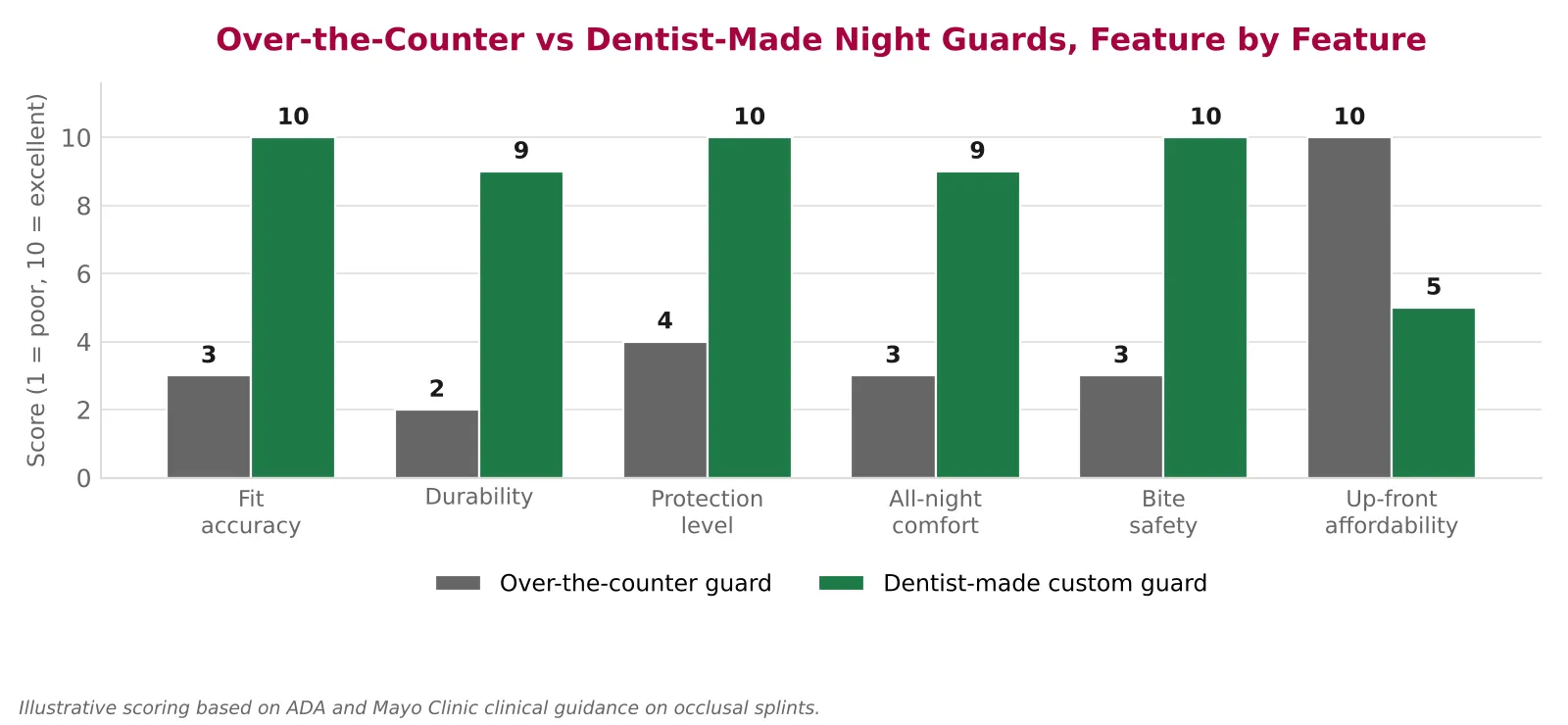
- Fit. A boil-and-bite moulds roughly. It tends to loosen, shift, or fall out overnight, which is why many people stop wearing them within weeks.
- Durability. Soft OTC material wears through fast under real grinding force. A few months is typical.
- Bite safety. This is the real concern. A guard that only covers some teeth, or sits unevenly, can let the uncovered teeth drift over months. That's a bigger problem than the one you started with.
Where OTC genuinely wins: price and availability. Where it doesn't: everything else. If you're grinding heavily, already have crowns or veneers, or have any jaw-joint symptoms, skip the drugstore and get examined — in those cases a poorly fitting guard can do real harm.
Is teeth grinding linked to sleep apnea?
Sometimes, and this is worth taking seriously — but carefully. Sleep bruxism is associated with obstructive sleep apnea in some patients, and the ADA recognises a screening role for dentists in identifying patients who should be evaluated further.
An association is not a diagnosis. Most people who grind their teeth do not have sleep apnea, and no dentist can diagnose it from a dental exam. Only a sleep study, ordered by a physician, can do that.
What's worth flagging to your doctor is the combination. If you grind your teeth and also:
- Snore loudly, or your partner notices you stop breathing
- Wake up gasping or choking
- Feel exhausted during the day despite a full night in bed
- Wake with a dry mouth or a morning headache most days
Then that pattern is worth raising with your physician, who can arrange a sleep study. The American Academy of Dental Sleep Medicine explains how dentists and physicians work together once a diagnosis exists. We'll flag what we see; the diagnosis belongs with your doctor.
Schedule a bruxism evaluation
Not sure whether it's grinding, clenching, or the joint? That's exactly what a bruxism evaluation is for.
When should you see a dentist about grinding?
Book an appointment if any of these apply:
- You wake with jaw soreness or temple headaches more than occasionally
- Someone has told you that you grind at night
- Your teeth look shorter, flatter, or more see-through at the edges than they used to
- You have new tooth sensitivity without an obvious cause
- Fillings or crowns are chipping or coming loose
- Your jaw clicks, catches, or locks
- You've been wearing an OTC guard and it isn't helping
A bruxism evaluation is straightforward: an exam of the teeth and jaw muscles, a look at wear patterns against previous records where we have them, a few questions about sleep and stress, and a clear explanation of what's actually happening. Dr. Jeffrey Brenner, DMD has practised in Southampton for over twenty years and checks for grinding at every exam. If a guard is the right answer, we'll say so. If the joint needs looking at first, we'll say that instead.
The short version
If you're waking with a sore jaw, get an over-the-counter guard tonight and an appointment this month. The drugstore guard buys you time; the exam tells you what's actually happening — whether it's grinding, the joint, or both — and what it will cost to protect your teeth properly. Hampton Family Dental is on Second Street Pike in Southampton, PA, and we reserve time daily for patients who need to be seen quickly.
Ask about custom night guards
Book a bruxism evaluation. We'll check your teeth and jaw, explain what we find, and verify your benefits so you know your cost before anything begins.