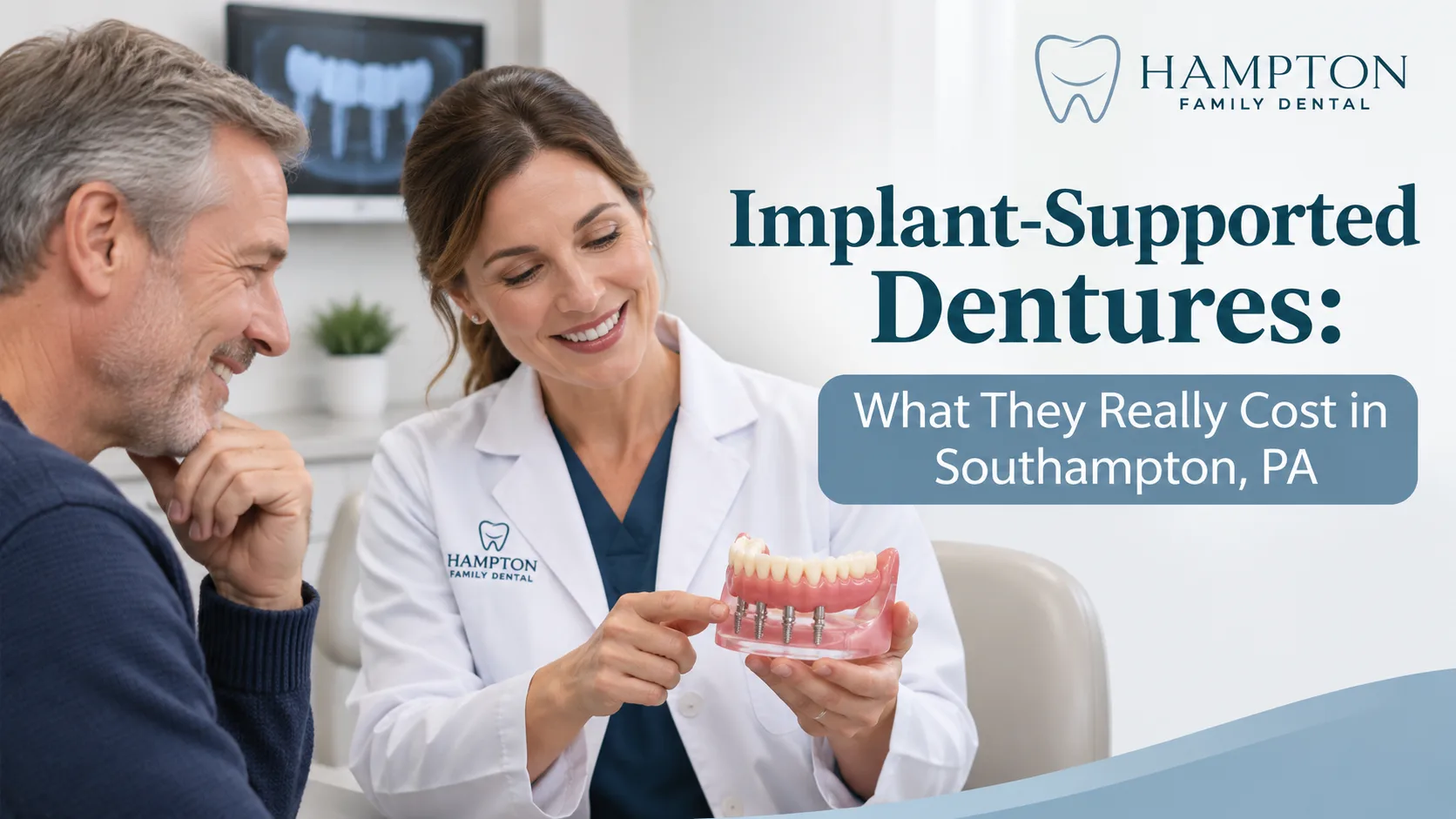
Implant-supported dentures typically cost $5,000 to $30,000 per arch without insurance. A snap-on overdenture with two implants runs $5,000 to $12,000; a fixed All-on-4 bridge runs $15,000 to $30,000. The type, the number of implants, bone grafting and materials decide where you land. At Hampton Family Dental in Southampton, PA, Dr. Keyur Dudhat plans every case with 3D imaging and gives you a written estimate first.
The short version
- Implant-supported dentures cost $5,000 to $30,000 per arch. The range exists because there are fundamentally different products at different price points.
- The price includes implants, abutments, the denture or bridge, potentially bone grafting, a temporary, and imaging. A single number hides all of that.
- Over 10 years, the total-cost gap between traditional dentures and implant-supported options narrows significantly once you factor in relines, replacements, and adhesive.
- Not everyone qualifies. Bone density, gum health, smoking, and medical conditions all affect candidacy — which is why the exam comes first.
- Insurance typically covers a fraction. Phasing treatment across two plan years and combining dental + medical insurance can significantly reduce your out-of-pocket cost.
What Are Implant-Supported Dentures?
Implant-supported dentures are a full set of replacement teeth anchored to dental implants placed in the jawbone, rather than resting on the gums the way a traditional denture does. Per ADA MouthHealthy — Implants, the implants fuse with the bone over several months (a process called osseointegration), creating a stable foundation that holds the denture firmly in place.
The result is a denture that doesn't slip, doesn't need adhesive, allows you to eat a much wider range of food, and helps slow the bone loss that happens naturally when teeth are missing. See dentures at Hampton Family Dental for a comparison with traditional options, or dental bridges for an alternative when only some teeth are missing.
Snap-On vs Fixed: The Two Main Types
There are two fundamentally different products, and the cost difference between them is large:
Snap-On Overdentures (Removable)
A snap-on overdenture clips onto implants using locator attachments or a connecting bar. You can remove it yourself for cleaning. It typically uses 2 to 4 implants per arch.
Who it's for: patients who want more stability than a traditional denture at a lower cost than a fixed bridge. It's also the option for patients who prefer to remove their teeth for cleaning or who don't have enough bone for a full fixed arch.
Cost per arch: $5,000 to $18,000 depending on the number of implants (2 vs 4) and the attachment system.
Fixed Implant Bridges (All-on-4 / All-on-6)
A fixed implant bridge is permanently attached to 4 to 6 implants per arch. Only a dentist can remove it. It looks and functions closer to natural teeth than any other denture option.
Who it's for: patients who want the closest thing to natural teeth, can afford the higher cost, and have adequate bone (or are willing to do grafting). The All-on-4 technique was designed to work with less bone by angling the rear implants.
Cost per arch: $15,000 to $30,000 depending on the number of implants, the material (acrylic vs zirconia), and whether bone grafting is needed.
| Snap-On Overdenture | Fixed Implant Bridge | |
|---|---|---|
| Implants per arch | 2–4 | 4–6 |
| Removable? | Yes — you remove it daily for cleaning | No — stays in permanently; dentist removes for maintenance |
| Cost per arch | $5,000–$18,000 | $15,000–$30,000 |
| Chewing ability | Good — much better than traditional dentures | Excellent — closest to natural teeth |
| Bone requirement | Moderate — 2 implants need less bone | Higher — though All-on-4 technique helps with less bone |
| Maintenance | Replace clips/attachments every 1–2 years ($100–$300) | Annual professional cleaning + checkup |
| Available at Hampton | Yes | Yes |
How Much Do Implant-Supported Dentures Cost?
Here's the honest answer, and the reason the range is so wide:
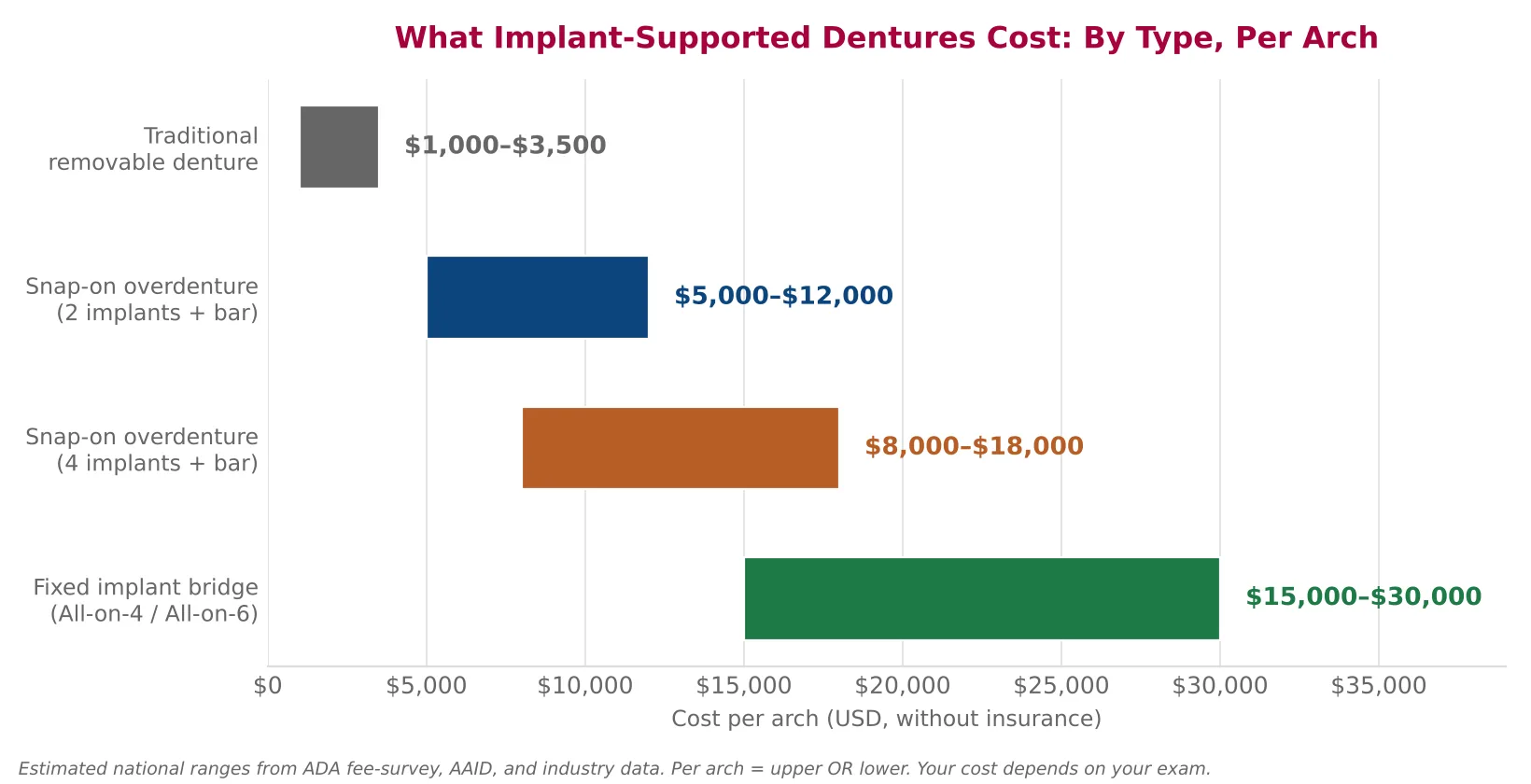
Per-Arch Cost by Type
| Option | Cost Per Arch | Implants | Best For |
|---|---|---|---|
| Traditional removable denture | $1,000–$3,500 | None | Budget; non-surgical preference; medical contraindications |
| Snap-on overdenture (2 implants) | $5,000–$12,000 | 2 | Better stability at a moderate cost; limited bone |
| Snap-on overdenture (4 implants) | $8,000–$18,000 | 4 | Strong stability; removable for cleaning |
| Fixed implant bridge (All-on-4/6) | $15,000–$30,000 | 4–6 | Closest to natural teeth; permanent |
What's Actually in the Price
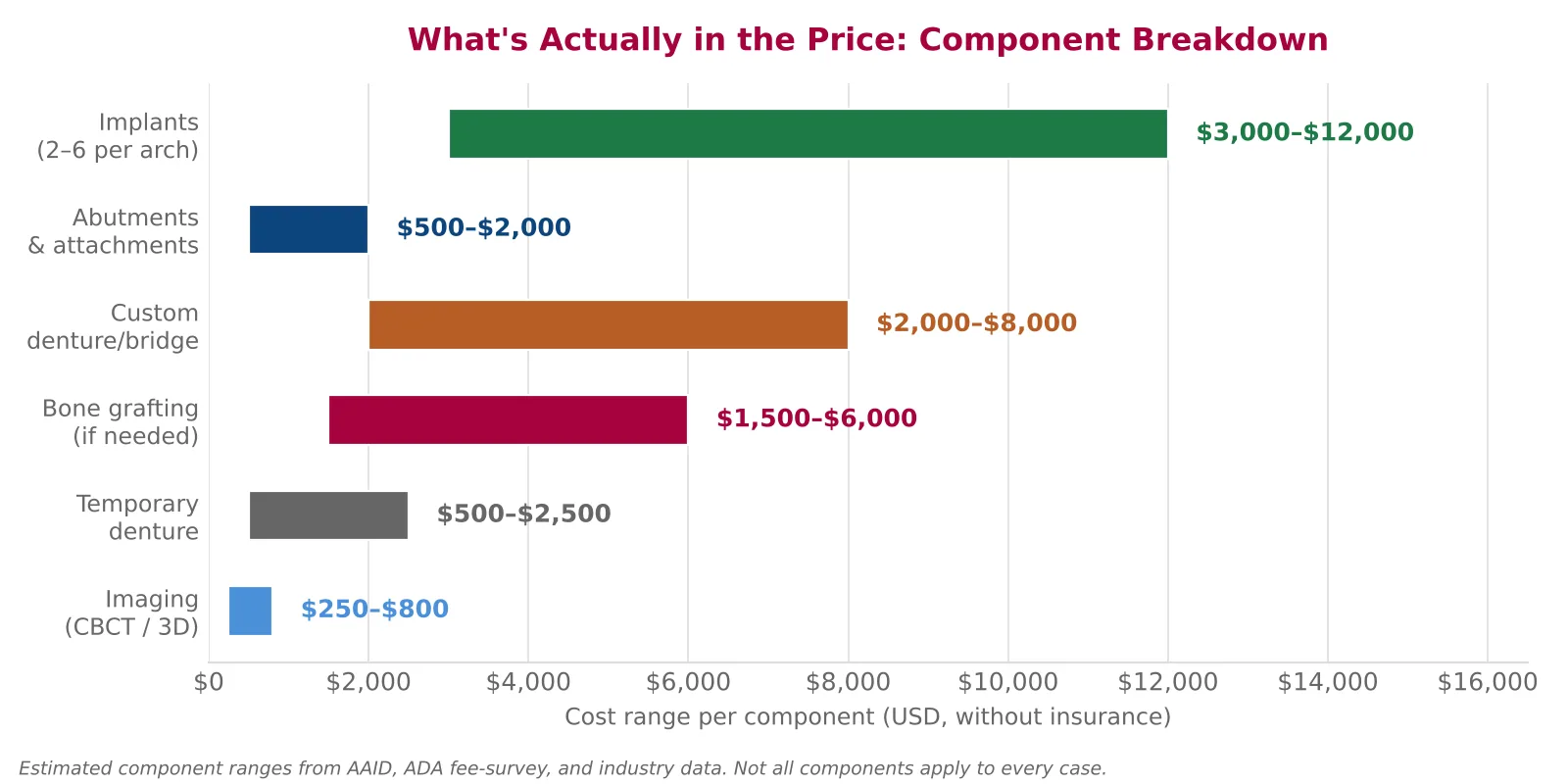
That $15,000–$30,000 for a fixed bridge is not one line item. Here's where the money goes:
| Component | Typical Range | Notes |
|---|---|---|
| Implants (2–6 per arch) | $3,000–$12,000 | The titanium posts placed in the jawbone — the largest single cost |
| Abutments & attachments | $500–$2,000 | The connectors between implant and denture/bridge |
| Custom denture or bridge | $2,000–$8,000 | The visible teeth; acrylic is cheaper, zirconia lasts longer |
| Bone grafting (if needed) | $1,500–$6,000 | Builds up bone that has resorbed after tooth loss; not every patient needs this |
| Temporary denture | $500–$2,500 | Worn during the 3–6 month healing period |
| 3D imaging (CBCT) | $250–$800 | The 3D scan that maps bone density and plans implant positions |
Not all components apply to every case. A patient with adequate bone who chooses a 2-implant snap-on with an acrylic denture sits at the lower end. A patient needing bone grafting, 6 implants, and a zirconia bridge sits at the upper end. That is why the range is wide — and why a single quoted number tells you almost nothing.
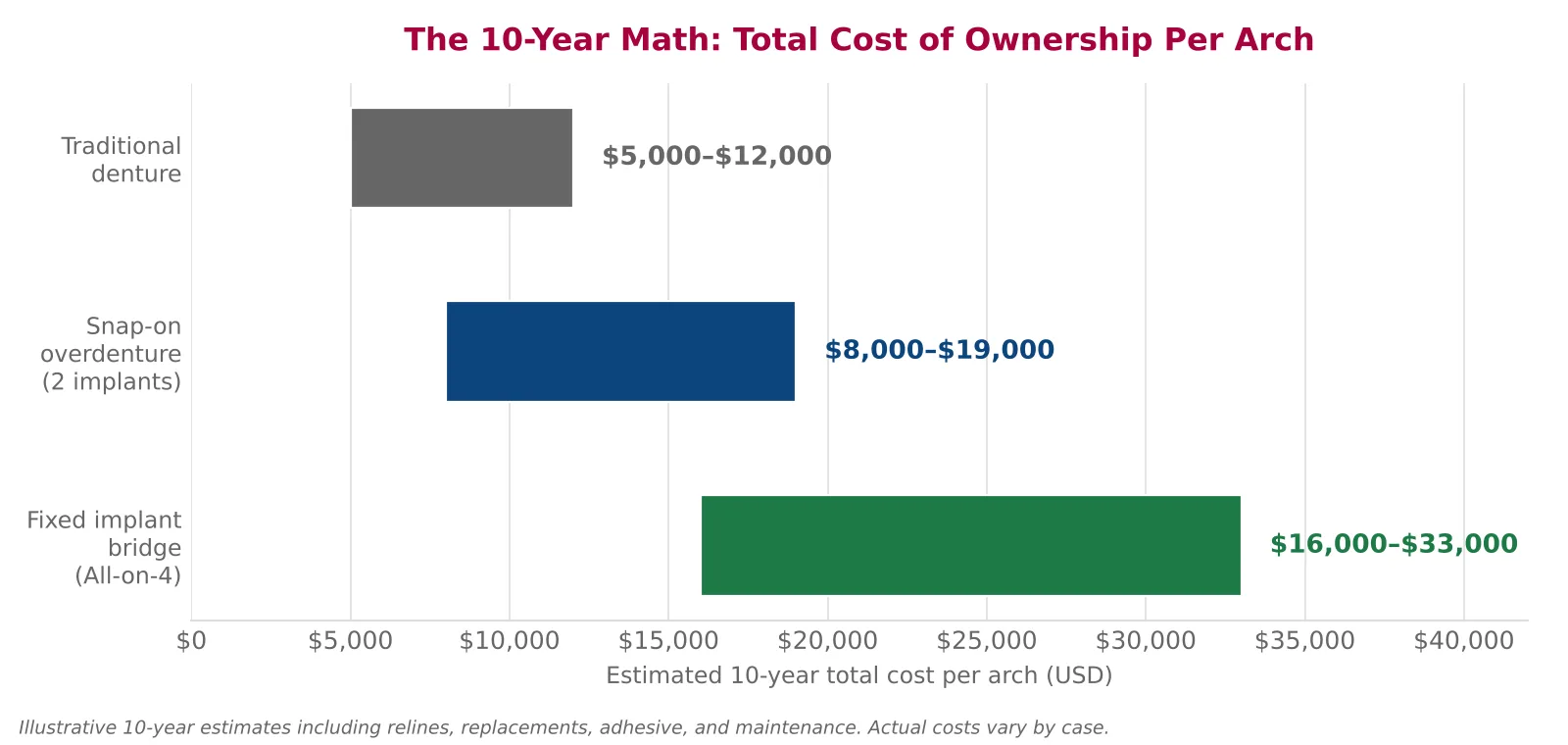
The 10-Year Math: Total Cost of Ownership
The up-front cost of implant-supported dentures is significantly higher than traditional dentures. But the total cost over a decade tells a different story, because traditional dentures carry ongoing costs that implant-supported ones largely avoid:
- Relines ($300–$500 every 1–2 years) — the jaw changes shape as bone resorbs, and the denture stops fitting
- Replacements ($1,000–$3,500 every 5–7 years) — denture teeth wear down and the base degrades
- Adhesive ($150–$250 per year) — ongoing
- Additional office visits for adjustments
Implant-supported options slow bone loss (which reduces relining) and eliminate adhesive entirely. A fixed bridge needs professional cleaning and occasional component replacement, but the structure itself can last decades. See traditional and implant-supported denture options for more on the differences.
What Affects Your Cost?
Six factors that move you around within the ranges above:
- Type of denture (snap-on vs fixed) — the single biggest cost driver.
- Number of implants (2 vs 4 vs 6 per arch) — more implants = more stability and more cost.
- Bone grafting — adds $1,500–$6,000 and several months if needed.
- Materials (acrylic vs zirconia for the denture/bridge; titanium vs zirconia for the implants) — zirconia costs more and lasts longer.
- Lab and prosthetic work — a custom-milled zirconia bridge costs significantly more than an acrylic one.
- Geographic location — costs in Bucks County, PA tend to run below Manhattan or Center City Philadelphia rates but above rural areas.
Does Insurance Cover Implant-Supported Dentures?
The short answer is: partially. Here's how it actually works:
Dental insurance: most plans classify implants as a major procedure and cover 50% up to the annual maximum — typically $1,500 to $2,000 per year. On a $20,000 treatment, that covers a fraction of the total. Coverage varies widely by plan; some plans exclude implants entirely.
Medical insurance: some patients qualify for medical (not dental) coverage of the surgical implant placement when it's deemed medically necessary — for example, when bone loss from missing teeth affects jaw function. This is not guaranteed and requires pre-authorization.
Phased treatment strategy: because implant-supported dentures take months to complete, treatment can often be phased across two calendar years. This lets you use two annual maximums from your dental plan — effectively doubling the available benefit. Our office coordinates this timing with your plan year.
If you're uninsured, our Adult Complete membership plan is $312 a year. It covers two cleanings, two exams and routine X-rays, and takes 10% off implant treatment and 15% off other procedures. We'll verify your benefits before any treatment so you know your out-of-pocket number in advance.
Request an implant denture cost estimate
Get a 3D scan, a bone assessment and an itemized written estimate for your case before anything begins.
Are You a Candidate?
Not everyone qualifies for implant-supported dentures, and an honest cost conversation starts with candidacy. Per Mayo Clinic — Dental Implant Surgery, the factors that affect whether implants will work for you include:
- Jawbone density and volume — implants need bone to fuse with. A 3D scan shows exactly how much is available.
- Gum health — active gum disease must be treated before implant placement.
- Smoking — significantly increases implant failure rates. Many implant dentists require patients to quit before surgery.
- Medical conditions — uncontrolled diabetes, certain autoimmune conditions, radiation therapy to the jaw, and some medications (bisphosphonates) affect bone healing.
- Age — implants are typically placed in adults whose jaws have finished growing (age 18+). There is no upper age limit if health permits.
Bone loss is not automatically a disqualifier. Moderate bone loss can often be addressed with grafting, and the All-on-4 technique was specifically designed to work with less bone by angling the rear implants. But it does add cost and time. See implant options in Southampton for more on how Dr. Dudhat evaluates candidacy.
What Does the Process Look Like?
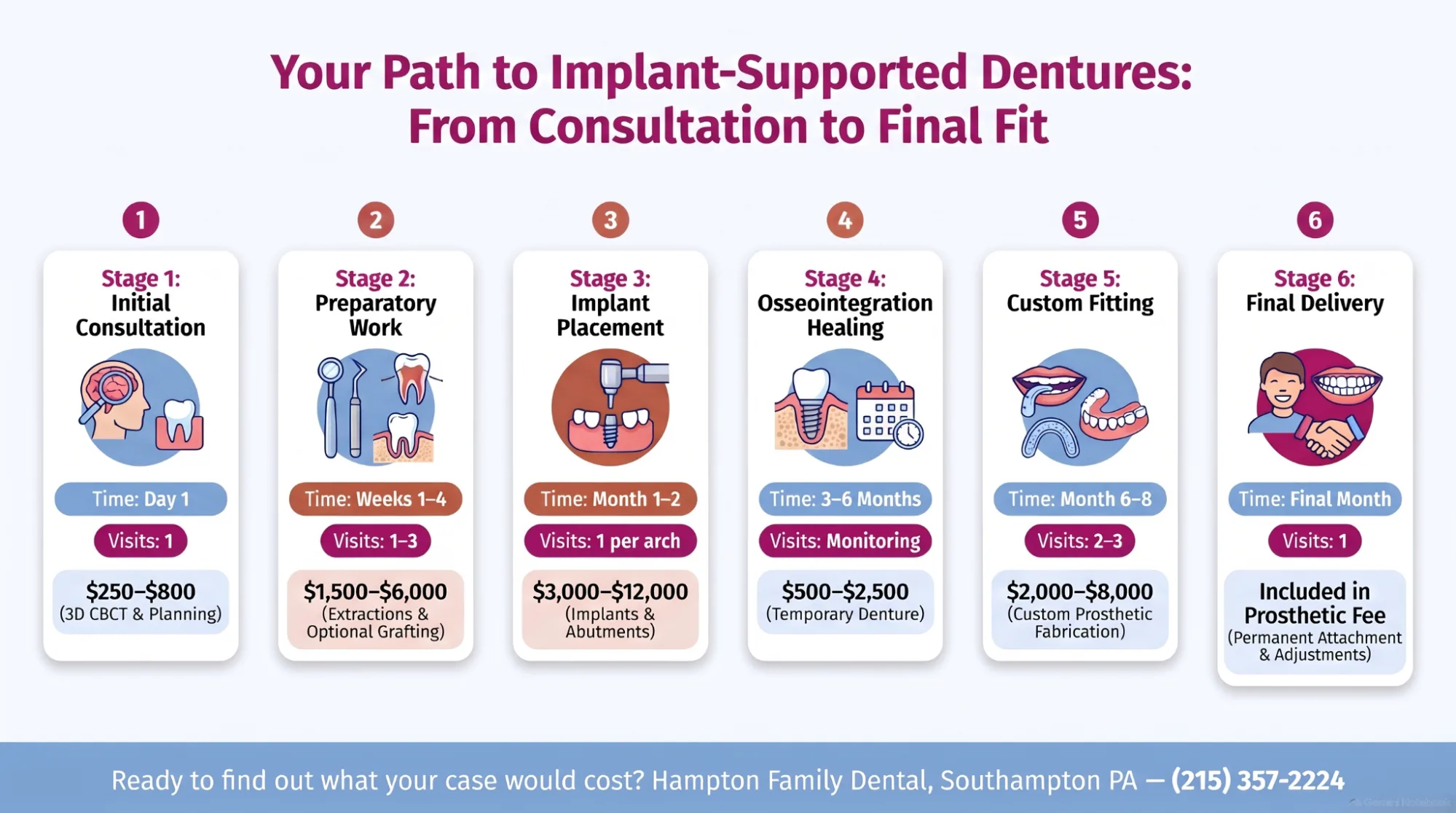
The timeline from consultation to final delivery is typically 4 to 12 months, depending on whether bone grafting is needed and how quickly your implants integrate. For the full step-by-step, see what to expect during the implant process. Here's the overview:
- Consultation + 3D imaging (1 visit) — CBCT scan, oral exam, treatment plan with written cost estimate.
- Preparatory work (1–3 visits, if needed) — extractions, bone grafting, gum treatment.
- Implant placement (1 visit per arch) — the implants are surgically placed into the jawbone.
- Healing (3–6 months) — the implants fuse with the bone. A temporary denture is worn during this time.
- Impressions + fitting (2–3 visits) — the custom denture or bridge is fabricated.
- Final delivery (1 visit) — the permanent prosthetic is placed and adjusted.
How Long Do Implant-Supported Dentures Last?
The implants themselves can last decades with good oral hygiene and regular dental visits, according to the ADA and Cleveland Clinic. The denture or bridge attached to them has a separate lifespan:
- Acrylic denture/bridge: 10–15 years before replacement or major refurbishment
- Zirconia bridge: 15–20+ years
- Snap-on attachments (locators/clips): replacement every 1–2 years ($100–$300 per set)
Grinding your teeth, chewing ice, smoking, and skipping dental checkups all shorten lifespan. The best protection is regular maintenance — and a night guard if you grind.
How Your Southampton Implant Dentist Plans Your Case
Dr. Keyur Dudhat plans every implant case at Hampton Family Dental using 3D CBCT imaging — a scan that maps bone density, nerve locations, and sinus proximity in three dimensions before anything is placed. Here's the planning sequence:
- Step 1 — 3D scan and oral exam. The CBCT scan shows exactly how much bone is available, where the dense bone sits, and whether grafting is needed. No guessing.
- Step 2 — Digital treatment planning. Implant positions, angles, and depths are planned on the 3D model before surgery, reducing surgical time and improving accuracy.
- Step 3 — Written cost estimate. Every component is itemized: implants, abutments, denture/bridge, grafting if needed, temporaries, imaging. No single-number surprises.
- Step 4 — Insurance coordination. The office verifies dental and medical benefits and coordinates phased treatment timing with your plan year if applicable.
- Step 5 — Your decision. With the full picture in front of you — cost, timeline, candidacy, alternatives — you decide. Restorative dentistry services at Hampton covers the full range, so the recommendation is based on your case, not on what's available.
The Short Version
Implant-supported dentures cost $5,000 to $30,000 per arch because there are four fundamentally different products inside that range, and three variables — implant count, bone grafting, and materials — that move each one. The only way to know what your case costs is a 3D scan, a bone assessment, and a written estimate. Hampton Family Dental is on Second Street Pike in Southampton, PA. See new patient information for what to expect at your first visit.
Book a candidacy evaluation
Find out which type fits your jaw and your budget. We'll take a 3D scan, check your bone, and give you an itemized written estimate.