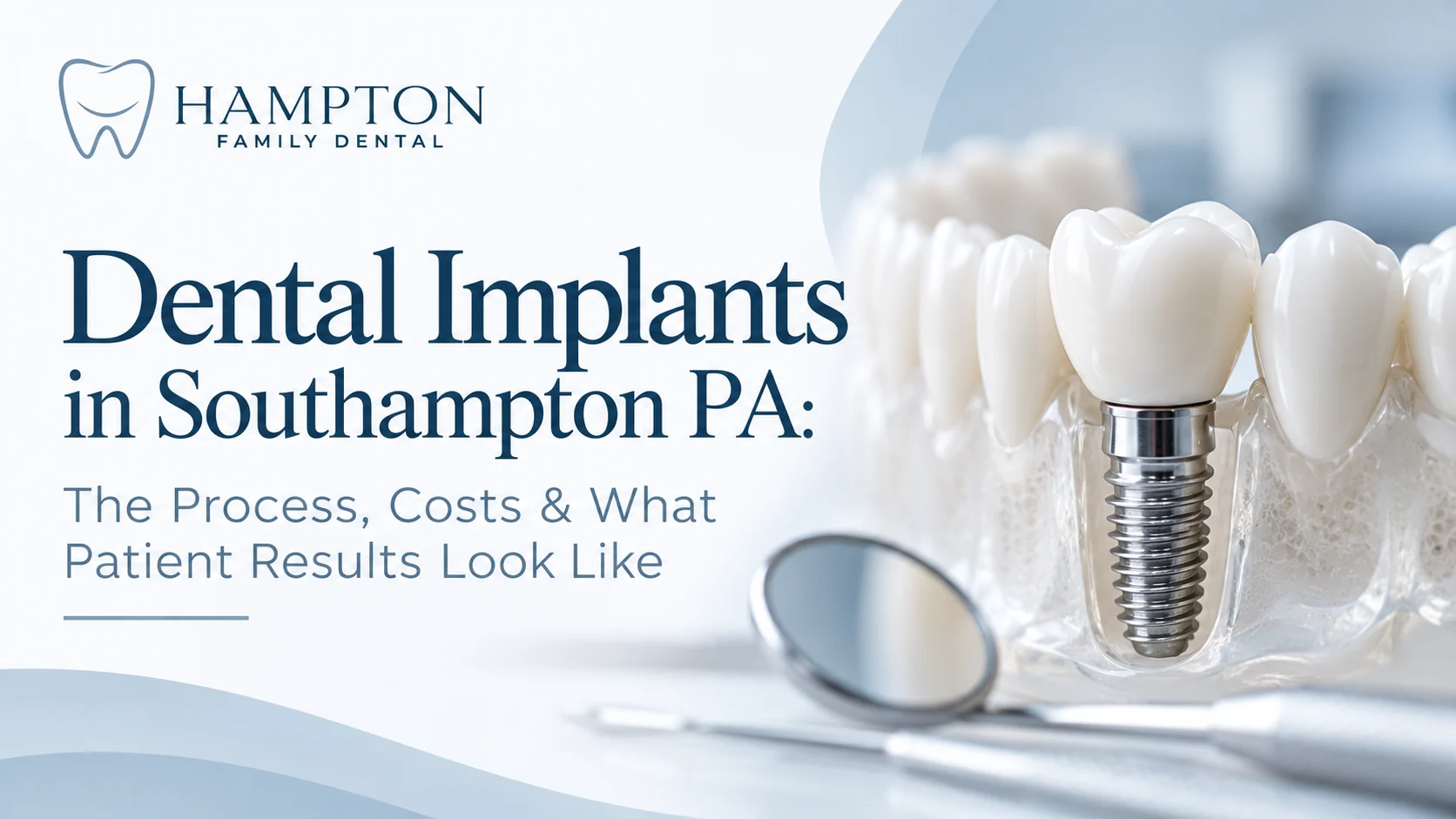
The dental implant process has five stages — consultation and 3D scan, extraction and bone graft if needed, implant post placement, osseointegration (3 to 6 months of healing), and final crown placement — and typically takes 6 to 9 months in total. National costs run $3,000 to $6,000 for a single-tooth implant and $30,000 to $50,000 for a full-mouth All-on-4 reconstruction. At Hampton Family Dental in Southampton, PA, Dr. Keyur Dudhat plans every implant case with 3D imaging so you see your projected result before you commit.
The short version
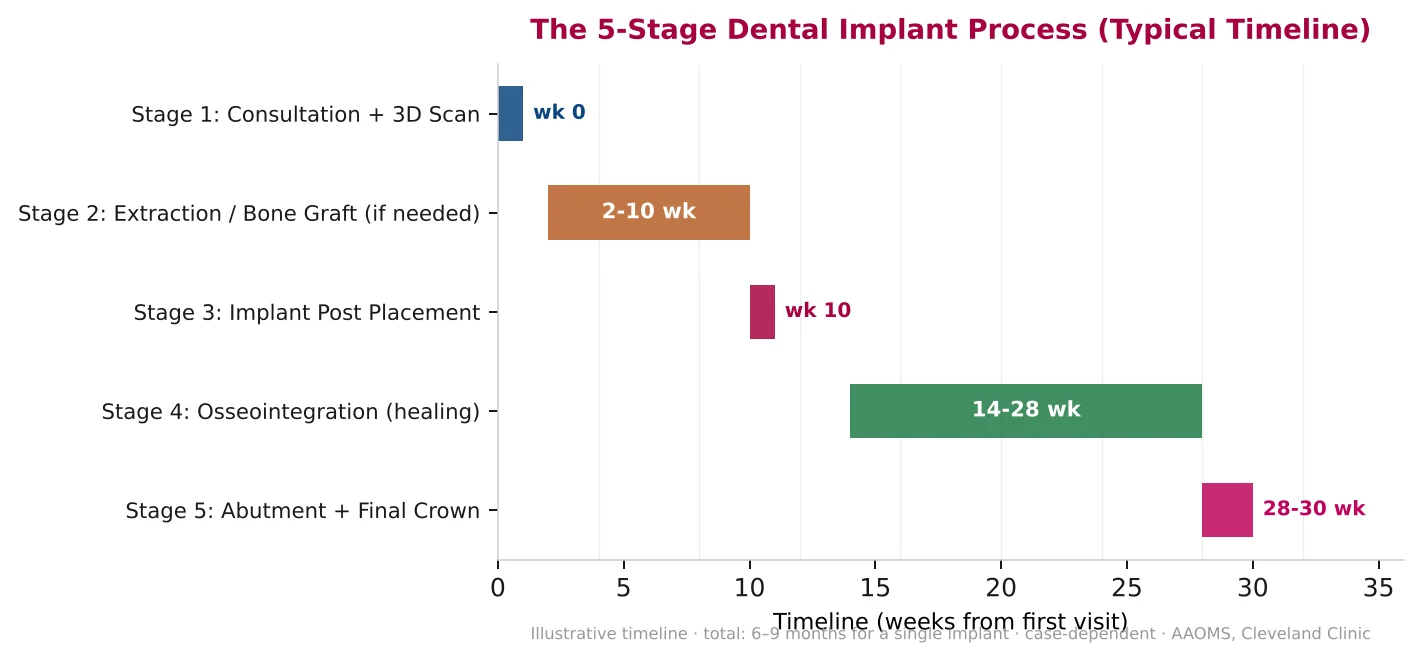
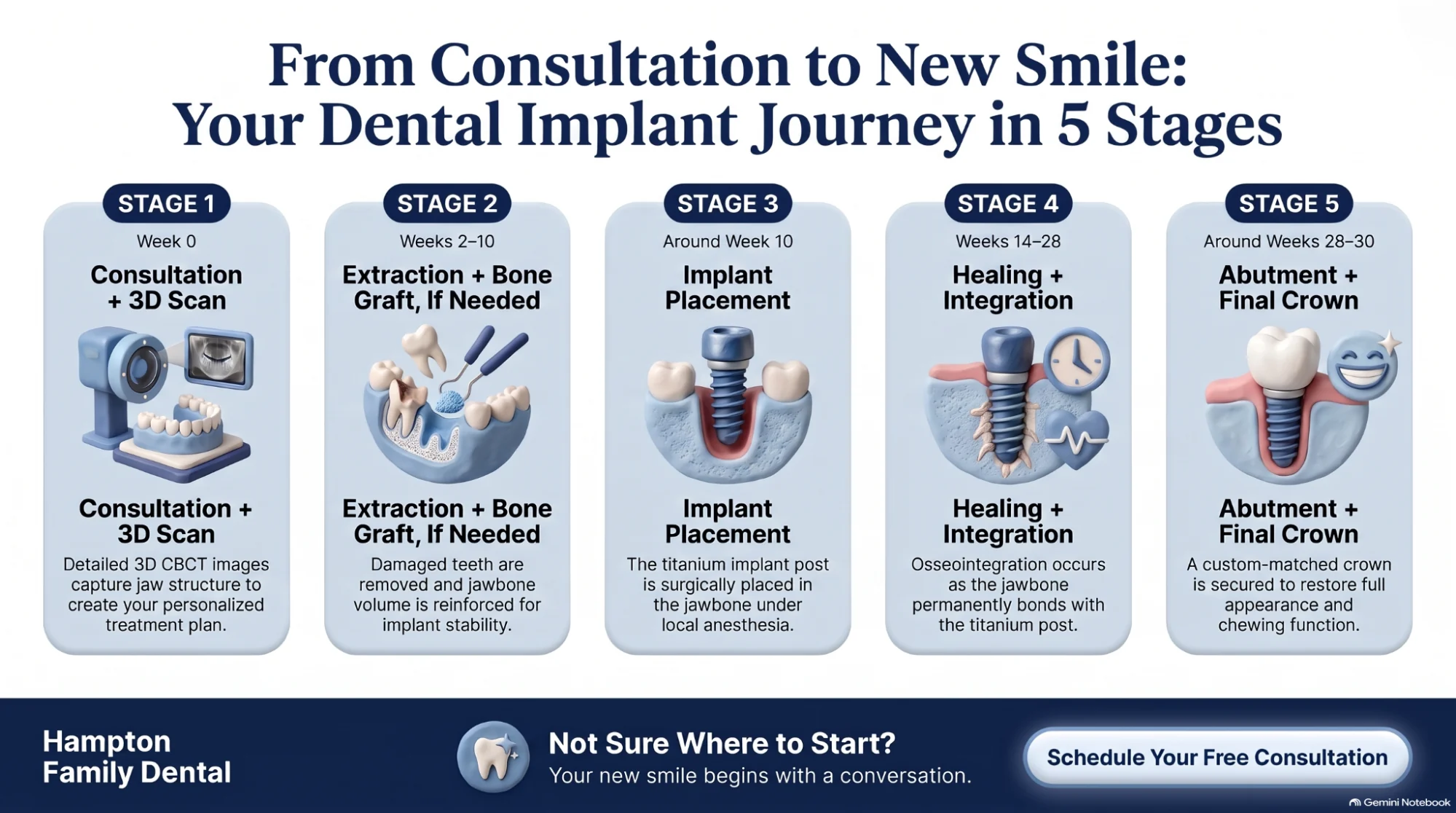
- The process has five stages: consultation and 3D scan, extraction or bone graft if needed, implant post placement, osseointegration healing, and the final crown.
- Most single-tooth implants take 6 to 9 months from first visit to final crown. Full-mouth cases can be done in a similar window with the All-on-4 approach.
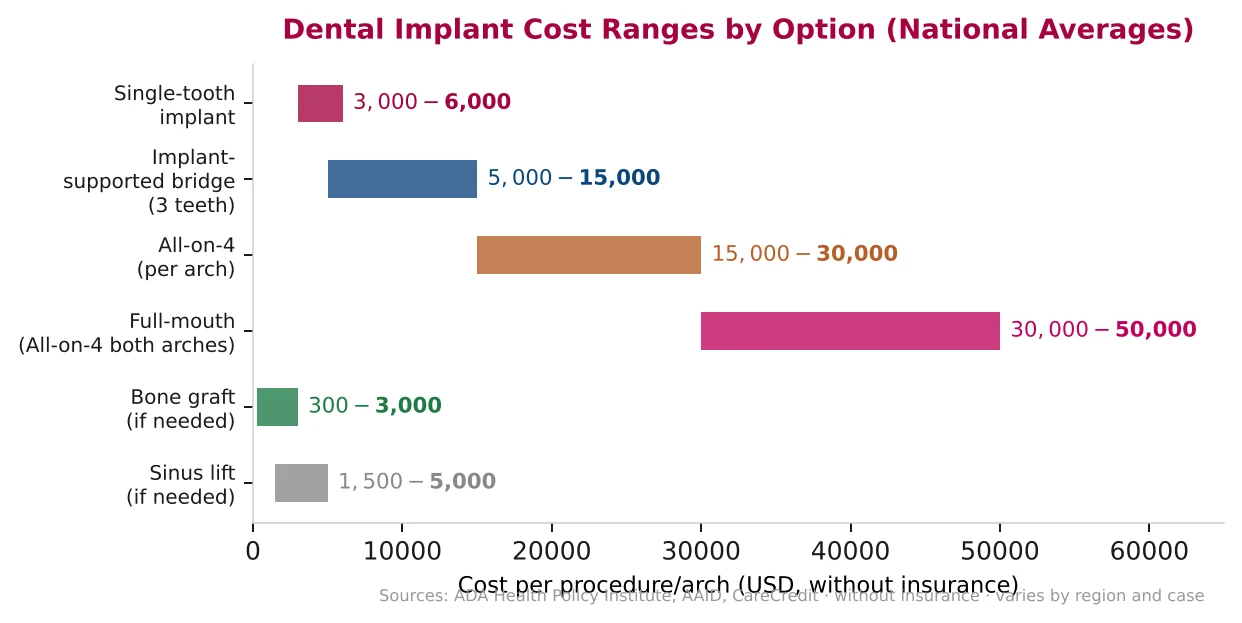
- National cost ranges: single-tooth $3,000–$6,000, implant bridge $5,000–$15,000, All-on-4 $15,000–$30,000 per arch, full-mouth $30,000–$50,000. Bone grafts and sinus lifts add $300–$5,000.
- According to AAOMS and NIDCR, implants have roughly a 97% success rate at one year and remain above 90% at 20 years when hygiene and checkups are maintained.
- At Hampton Family Dental, Dr. Dudhat plans every implant case with 3D imaging — you see the projected result and a written estimate before anything begins.
The 5-stage dental implant process, week by week
A dental implant replaces a missing tooth root with a titanium post that bonds to your jawbone, then supports a crown that looks and functions like a natural tooth. The process unfolds in five stages. For a full overview of what we offer, see dental implant services at Hampton Family Dental.
Stage 1 — Consultation and 3D scan
Your first visit is an evaluation. Your dentist takes a 3D cone-beam CT scan that shows your jawbone volume, nerve positions, sinus location, and the exact spots where implants can be placed safely. You see your projected result in digital planning software, get a clear written estimate, and leave with a step-by-step plan. If a tooth needs extracting first, or you need a bone graft, those get scheduled next. Timeline: one visit, usually 60 to 90 minutes.
Stage 2 — Extraction and bone graft (if needed)
If the failing tooth is still in place, it is extracted. If your jawbone lacks the volume to support an implant, a bone graft is placed at the same time or in a separate visit. Grafts take 3 to 6 months to integrate and strengthen the ridge. Not every patient needs one — your 3D scan decides it. If you don't, this stage is skipped entirely. Timeline: extraction day, plus 3 to 6 months of healing if a graft is placed.
Stage 3 — Implant post placement
The titanium implant post is surgically placed into your jawbone under local anesthesia, with sedation available. Guided surgery using the 3D scan means the post goes exactly where it was planned — no guesswork. You go home with soft-food instructions and over-the-counter pain management. Most patients return to desk work the next day; physically demanding jobs may need two or three days off. Timeline: one visit, typically 60 to 90 minutes per implant.
Stage 4 — Osseointegration (3 to 6 months)
This is the quiet stage, and it is the one that makes implants work. Osseointegration is the process where your jawbone cells grow directly onto the titanium surface, locking the implant permanently in place. You come in once or twice for quick checks. The rest of the time you are simply living normally — eating, working, sleeping — while your bone does the job. Your dentist confirms the implant is fully integrated before moving on. Timeline: 3 to 6 months.
Stage 5 — Abutment and final crown
Once osseointegration is confirmed, a small connector called an abutment is attached to the implant post, and your custom crown is placed on top, colour-matched to your natural teeth. From this visit on, you have a tooth that looks, feels, and functions like a natural one. Brush, floss, and keep up with checkups, and it should serve you for decades. Timeline: one to two visits over two to three weeks.
How much do dental implants cost in Bucks County?
Cost depends on what you are replacing and whether you need preparatory procedures first. These are national average ranges from the ADA Health Policy Institute and industry data; Bucks County sits in line with them.
| Option | National cost range | What it includes |
|---|---|---|
| Single-tooth implant | $3,000–$6,000 | Implant post, abutment and crown |
| Implant-supported bridge (3 teeth) | $5,000–$15,000 | Two implants supporting a 3-tooth bridge |
| All-on-4 (per arch) | $15,000–$30,000 | Four implants supporting a full fixed denture, one arch |
| Full-mouth (both arches) | $30,000–$50,000 | All-on-4 upper and lower |
| Bone graft (if needed) | $300–$3,000 | Added when jawbone volume is insufficient |
| Sinus lift (if needed) | $1,500–$5,000 | Added for upper-jaw cases when the sinus floor sits too low |
For a deeper breakdown, see our guide to how much dental implants cost. If you are still comparing options, our guide comparing implants, dentures and bridges walks through the alternatives.
On insurance: many dental plans cover a portion of implants when treatment is medically necessary, particularly the crown component. Our team will verify your insurance benefits before treatment. For patients without insurance, our in-house membership plan starts at $288/year and includes 10% off implant treatment plus 15% off most other procedures.
What are full mouth implants (All-on-4)?
Full-mouth dental implants replace an entire upper or lower arch. The most common approach today is All-on-4, where four strategically placed implant posts support a full fixed denture — giving you a non-removable, functional set of teeth without needing one implant per missing tooth.
- Patients with widespread tooth loss or failing teeth throughout one or both arches
- Current denture wearers who want a non-removable solution
- Patients who want a fixed smile without the time and cost of individual implants for every tooth
The advantage over traditional dentures: no slipping, no adhesives, better chewing function, and bone stimulation that prevents the jaw shrinkage dentures cause over time. National cost runs $15,000 to $30,000 per arch, or $30,000 to $50,000 for both. If you are weighing this against conventional dentures, our comparison of dentures and implant-supported dentures covers the trade-offs.
Is the dental implant procedure painful?
You should not feel pain during the surgery itself. Local anesthesia numbs the area completely — you feel pressure, not sharp discomfort. For patients who want more comfort, or who are having several implants placed at once, nitrous oxide, oral sedation, and IV sedation are available.
Post-procedure discomfort typically peaks in the first 24 to 72 hours. Most patients manage it with over-the-counter ibuprofen or acetaminophen, cold compresses, and rest. Prescription pain medication is available if needed, though many patients find they don't need it past day two. The honest verdict most patients give afterwards: it was less uncomfortable than they expected.
How long do dental implants last? Success rates over time
Dental implants have one of the highest long-term success rates of any dental procedure. According to AAOMS and NIDCR data, success stays above 90% even at the 20-year mark.
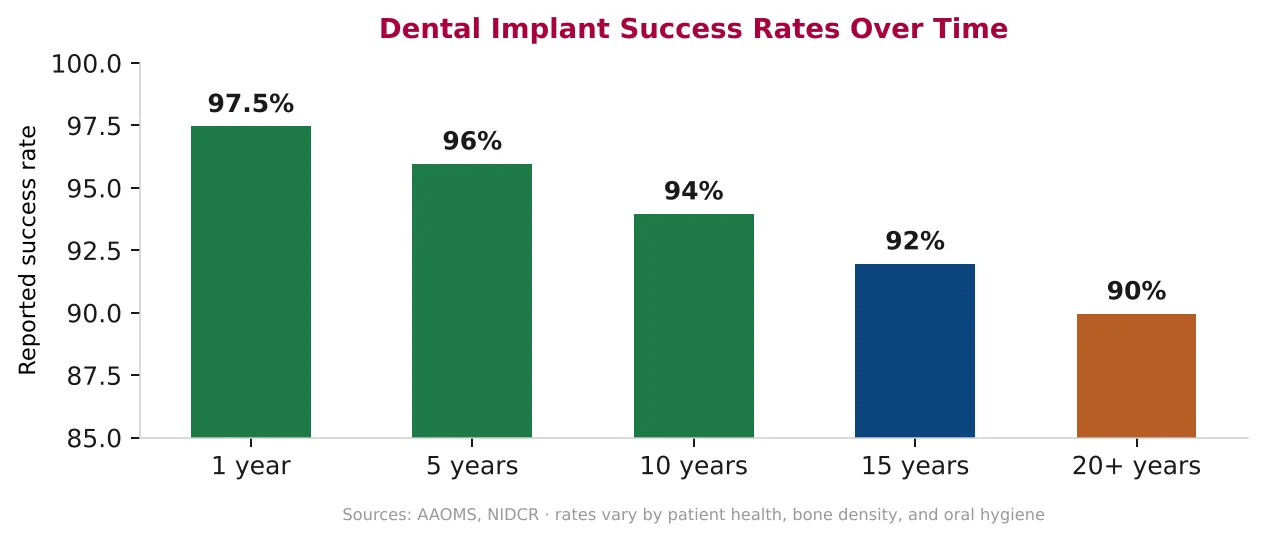
The implant post itself — the titanium screw — can last 25 years or more, and in many cases a lifetime, because titanium integrates permanently with jawbone. The crown on top typically needs replacing every 10 to 15 years from normal wear. Think of it like a car: the engine can run for decades, while the paint may need refreshing. What affects longevity is oral hygiene, smoking, overall health conditions like diabetes and osteoporosis, bone density, and keeping up with checkups. Our guide on how long dental implants last goes deeper.
Will I need a bone graft or sinus lift?
Not every patient does, and your 3D scan determines it before you commit to anything. You may need a bone graft if the tooth has been missing for years and the jawbone has shrunk, if you wore a denture that caused ridge resorption, or if the tooth was lost to periodontal disease that damaged the bone. You may need a sinus lift if the implant is going into the upper jaw molar area and the sinus floor sits too low for safe placement.
Both procedures are routine and safe, and both add 3 to 6 months of healing time. A bone graft costs $300 to $3,000 and a sinus lift $1,500 to $5,000. If you don't need either, your treatment moves faster and costs less.
Ready to see what your implant plan looks like?
Book a free implant consultation with a 3D scan. You'll get a projected result and a complete written estimate before any work begins.
How Hampton Family Dental plans every implant case
Dr. Dudhat uses 3D-imaging-guided planning for every implant case. Here is what that means in practice.
- Your 3D cone-beam scan shows exact bone volume, nerve positions, and sinus location
- Treatment planning software maps the ideal implant position before anything happens in your mouth
- You see the projected result on screen — what the implant will look like once it is in place
- Any preparatory work (extraction, bone graft, sinus lift) is identified and scheduled upfront
- You leave with a complete written treatment plan, timeline, and estimate
The practice has provided dental care in Southampton for over 20 years, and Dr. Keyur Dudhat brought advanced implant and cosmetic training to the team — which means care that once meant a referral elsewhere now happens here.