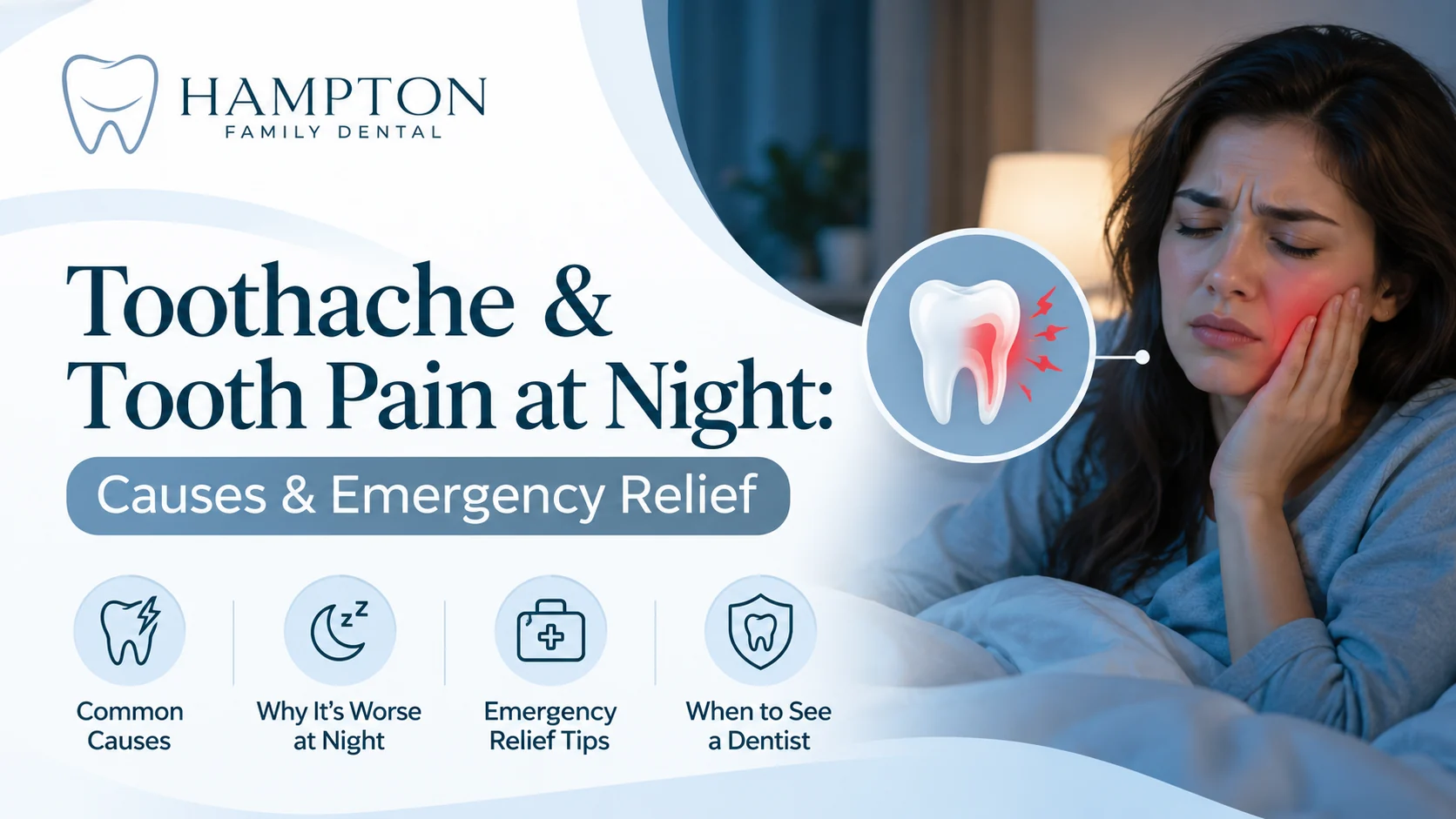
A toothache at night is usually caused by a cavity, an abscess, gum inflammation, or teeth grinding — and the pain often feels worse because lying flat sends more blood to your head and there are no daytime distractions. For mild pain, OTC ibuprofen, a cold compress, and a warm salt-water rinse can get you through the night. But if you have facial swelling, fever, pulsing throbbing pain, or difficulty swallowing, call an emergency dentist immediately — or 911 if your breathing is affected. At Hampton Family Dental in Southampton, PA, Dr. Jeffrey Brenner keeps same-day emergency slots open.
The short version
- Pain feels worse at night because lying flat increases blood flow to the head, there are fewer distractions, and nighttime grinding adds pressure.
- Safe home relief: OTC ibuprofen, a cold compress on the cheek, a warm salt-water rinse, and keeping your head elevated.
- Facial swelling, fever, or pulsing pain with a bad taste can signal a tooth abscess — that needs same-day attention, not a wait-and-see.
- Call 911 if facial swelling affects your breathing or swallowing. A serious dental infection can become life-threatening.
- Hampton Family Dental in Southampton, PA offers same-day emergency appointments. Call (215) 357-2224 as early in the day as you can.
When is a nighttime toothache a dental emergency?
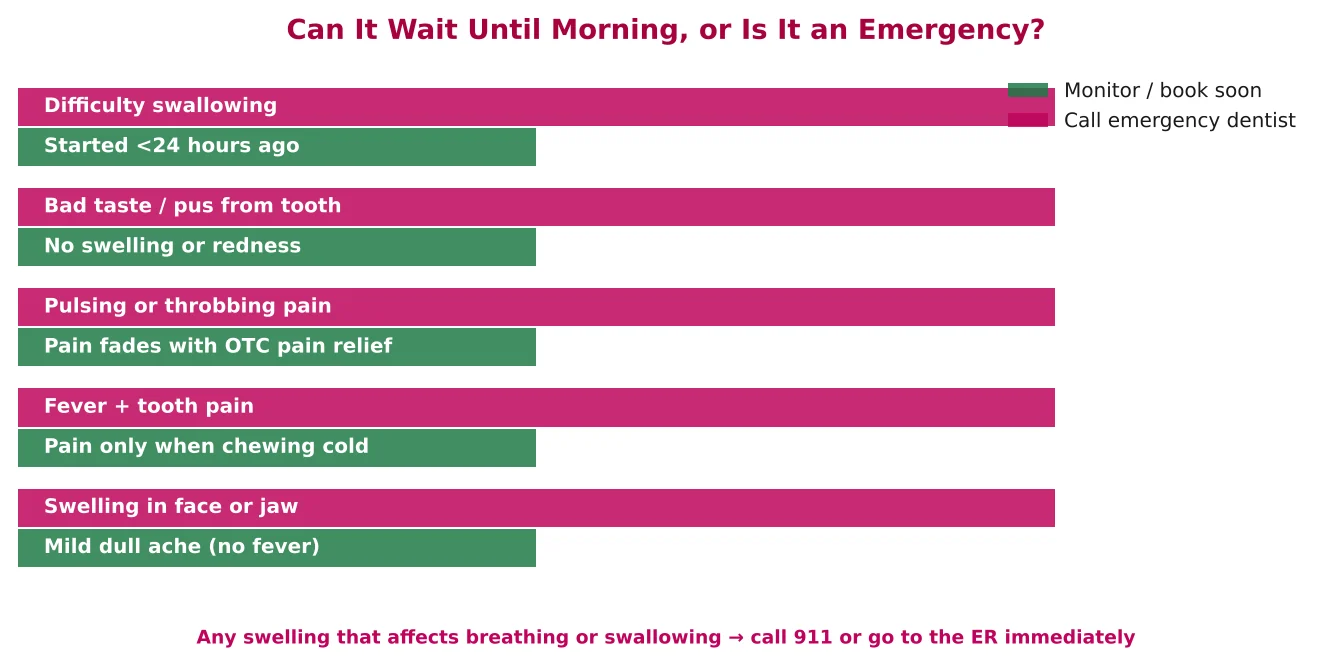
Not every nighttime toothache is a true emergency. Some can wait until morning for a regular appointment; others need attention right away. The difference usually comes down to whether there are signs of spreading infection — swelling, fever, pus — or just pain. Here is how to tell them apart.
When to call 911 or go to the ER
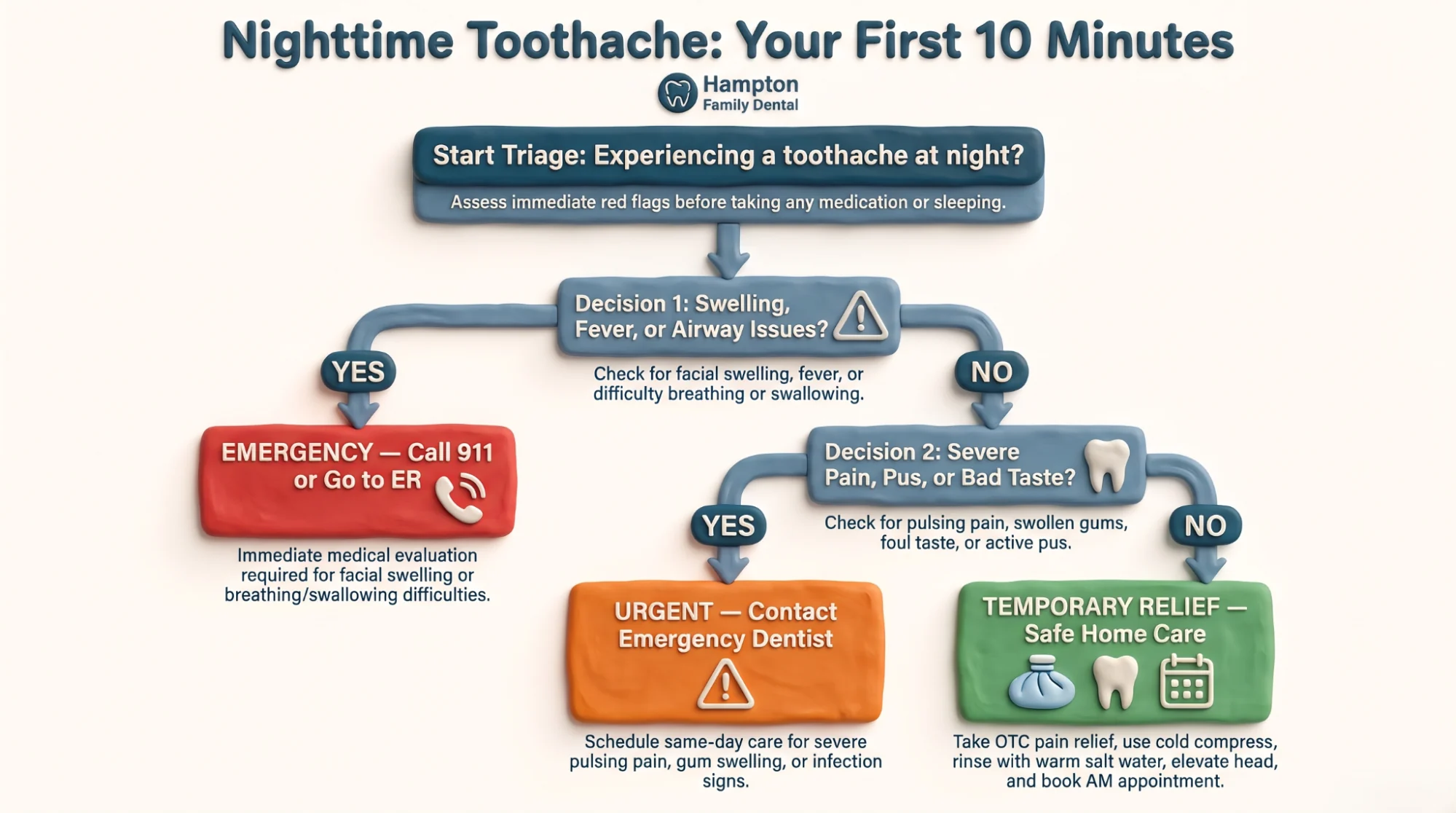
Go to the ER immediately — or call 911 — if you have facial, jaw, or neck swelling that affects your breathing or swallowing; a high fever of 102°F or above combined with tooth pain; uncontrolled bleeding from the mouth that won't stop with pressure; or if you feel very unwell, confused, or dizzy. A serious dental infection can spread quickly and, in rare cases, become life-threatening — a condition called Ludwig's angina. The ER can give you antibiotics and manage your airway while you follow up with an emergency dentist in Southampton PA for the dental treatment itself.
For other urgent dental problems — a knocked-out tooth, severe abscess pain without airway symptoms, a lost filling, or a crown that fell off — an emergency dentist is usually the right first call. For a fuller walkthrough, see our guide on what to do during a dental emergency.
Why does tooth pain feel worse at night?
You are not imagining it — dental pain really does intensify after dark. There are four main reasons, and they stack on top of each other.
- Lying flat increases blood flow to your head. Upright during the day, gravity pulls blood downward. When you lie down, more blood reaches your head and face, and that extra pressure around an already-inflamed tooth makes the throbbing worse.
- There are no daytime distractions. Work, conversation, and screens compete for your attention all day. At night, in quiet darkness, your brain has little else to focus on but the pain signal.
- Teeth grinding during sleep (bruxism). Many people clench or grind without knowing it. For a tooth already sore from decay or inflammation, that added pressure is enough to trigger pain.
- Lower cortisol at night. Cortisol — a natural anti-inflammatory your body produces — is at its lowest overnight, so your pain tolerance is genuinely reduced during sleeping hours.

What causes a toothache at night?
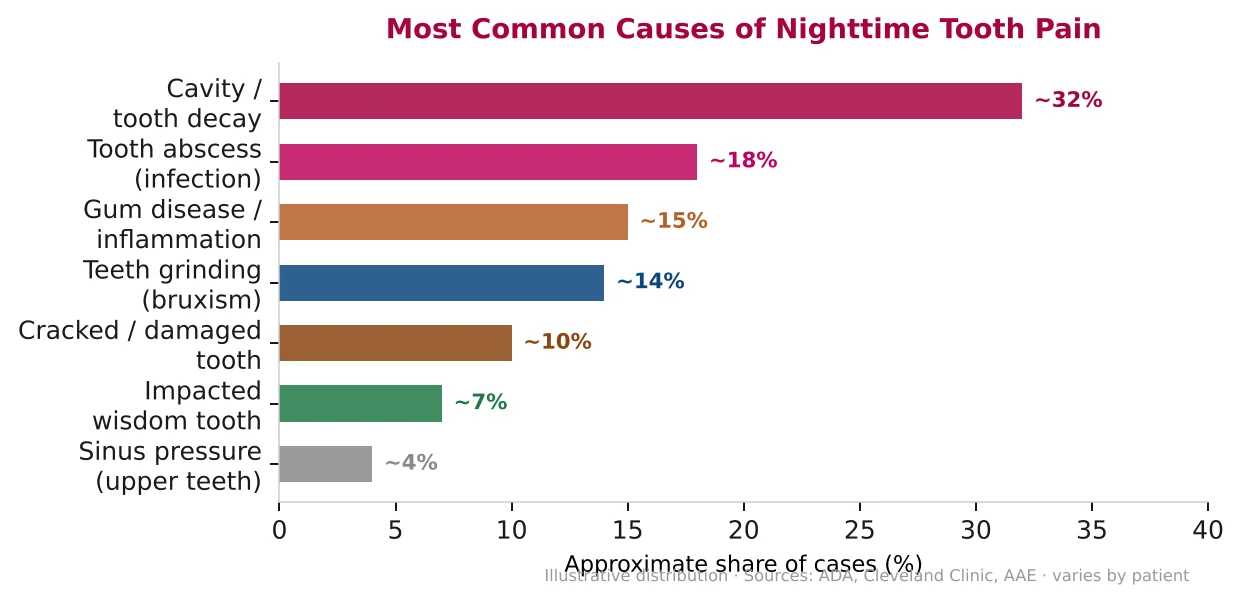
Most nighttime tooth pain traces back to one of these causes:
- Cavity (tooth decay) — the most common cause. Once decay reaches the sensitive inner layer of the tooth, pain becomes noticeable, especially after sugar, heat, or cold.
- Tooth abscess (infection) — a serious infection at the root of the tooth or in the surrounding bone. The pain is typically pulsing or throbbing, and it needs same-day attention.
- Gum disease or inflammation — swollen, infected gums cause a dull, persistent ache that often peaks at night.
- Teeth grinding (bruxism) — chronic grinding inflames the tooth's internal nerve and the surrounding muscles, leaving you sore with a headache by morning.
- Cracked or damaged tooth — a tiny crack lets bacteria and temperature changes reach the nerve, causing sharp pain when you bite down.
- Impacted wisdom tooth — a wisdom tooth that can't fully emerge causes gum inflammation (pericoronitis) and radiating pain.
- Sinus pressure — a sinus infection or congestion can mimic upper molar pain, because those roots sit close to the sinus floor.
If you recently had a tooth extracted and this pain feels different — sharp, starting three to five days afterwards, with a bad taste — read our guide on dry socket symptoms and relief.
How to stop a toothache at night fast: safe home relief
These steps are safe to try while you wait for a morning appointment. None of them fix the underlying cause — only a dentist can do that — but they can get you through the night.
- Take OTC pain relief. Ibuprofen (Advil, Motrin) is usually most effective because it reduces inflammation as well as pain. Acetaminophen (Tylenol) also works. Follow the label directions.
- Apply a cold compress. Twenty minutes on the outside of the cheek, twenty minutes off. Cold narrows blood vessels and dulls the pain signal.
- Rinse with warm salt water. Half a teaspoon of salt in 8 oz of warm water, swished gently for 30 seconds and spat out. It reduces inflammation and loosens debris.
- Keep your head elevated. Prop yourself up with an extra pillow or two to ease the blood-flow pressure on the painful tooth.
- Avoid triggers. Hot, cold, sugary, and acidic food and drink all spike dental pain. Stick to lukewarm, soft food until you can be seen.
- Try clove oil. Clove oil contains eugenol, a natural analgesic. Dab a tiny amount on a cotton swab and apply it to the sore area — do not swallow it, and do not use it on an open wound.
What is an abscessed tooth, and why is it serious?
A tooth abscess is a pocket of pus caused by a bacterial infection in the tooth's root or in the bone around it. According to the American Association of Endodontists, abscesses can turn serious quickly and will not clear up on their own.
- Pulsing, throbbing pain — often constant, often severe
- Pain radiating to the jaw, ear, or neck
- Facial, jaw, or cheek swelling
- Fever
- A bad taste in your mouth, or visible pus around the tooth
- Tender or swollen lymph nodes under the jaw or in the neck
- Sensitivity to pressure or chewing
An abscess needs same-day treatment. The dentist drains the infection, prescribes antibiotics if needed, and either treats the tooth with a root canal or, if it cannot be saved, extracts it. Left alone, the infection can spread to the jaw, the neck, the bloodstream (sepsis), or the airway — rare, but serious. If you suspect an abscess, don't wait: call (215) 357-2224 at the earliest opportunity. If swelling is affecting your breathing or swallowing, go to the ER instead.
How to sleep with tooth pain
Getting through the night is possible with the right setup:
- Take OTC pain relief about 30 minutes before bed so it is working as you fall asleep
- Elevate your head with an extra pillow or two to reduce blood-flow pressure
- Sleep on the opposite side if the pain is one-sided
- Avoid hot, cold, or sugary food and drink in the two hours before bed
- Rinse with warm salt water right before lying down
- Keep a cold compress within reach in case the pain spikes
- Set an alarm for your next dose of pain relief, following the label directions
If the pain is severe enough that you cannot sleep at all despite these steps, call an emergency dentist. That usually points to a problem that cannot wait.
How Hampton Family Dental handles emergency appointments
Hampton Family Dental in Southampton, PA keeps same-day emergency slots open during office hours — Monday 8–6, Tuesday 8–4, Wednesday 9–1, and Thursday 8–4. Dr. Jeffrey Brenner has handled dental emergencies in this community for over 20 years.
- Call (215) 357-2224 as early in the day as you can — same-day slots fill up.
- Describe your symptoms honestly: swelling, fever, how severe the pain is, how long it has been going on. It helps the team triage you properly.
- For after-hours emergencies, the voicemail gives guidance. If swelling is affecting your breathing, do not wait for a callback — go to the ER.
On cost: emergency dental visits are often covered by insurance, and our team will verify your insurance coverage before treatment. We also run a $59 emergency visit special that covers a focused exam and the necessary X-rays. For patients without insurance, our in-house membership plan starts at $288/year and includes 15% off other procedures.
In pain right now?
Call (215) 357-2224 for a same-day emergency appointment, or book online and we'll get you in as quickly as we can.