
Dental bonding uses tooth-colored composite resin applied in a single visit to repair chips, gaps, or small cosmetic concerns — $100 to $600 per tooth, reversible, lasting 3 to 10 years. Porcelain veneers are custom-made shells placed over the front of your teeth across two to three visits — $925 to $2,500 per tooth, considered permanent, lasting 10 to 15 years and often 20 or more. At Hampton Family Dental in Southampton, PA, Dr. Keyur Dudhat performs both and will show you which fits your case at a cosmetic consultation.
The short version
- Bonding is faster, cheaper, and reversible. Veneers last longer, resist staining better, and are permanent.
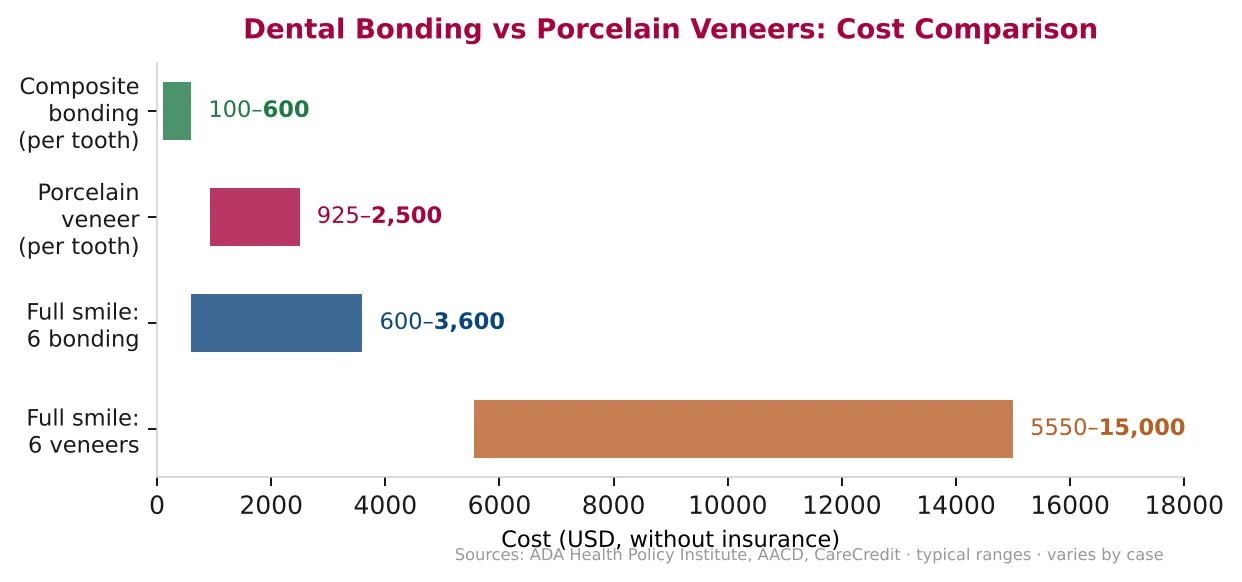
- Cost: bonding $100–$600 per tooth, veneers $925–$2,500 per tooth. A six-tooth smile runs $600–$3,600 in bonding or $5,550–$15,000 in veneers.
- Lifespan: bonding 3 to 10 years, porcelain veneers 10 to 15 years and often 20 or more with good care.
- For a single chipped tooth, bonding is usually the better value. For a full smile makeover, veneers give the longer-lasting result.
- You can mix both across different teeth. Hampton Family Dental performs both procedures, so the recommendation follows your case rather than what the office happens to offer.
Dental bonding vs veneers at a glance
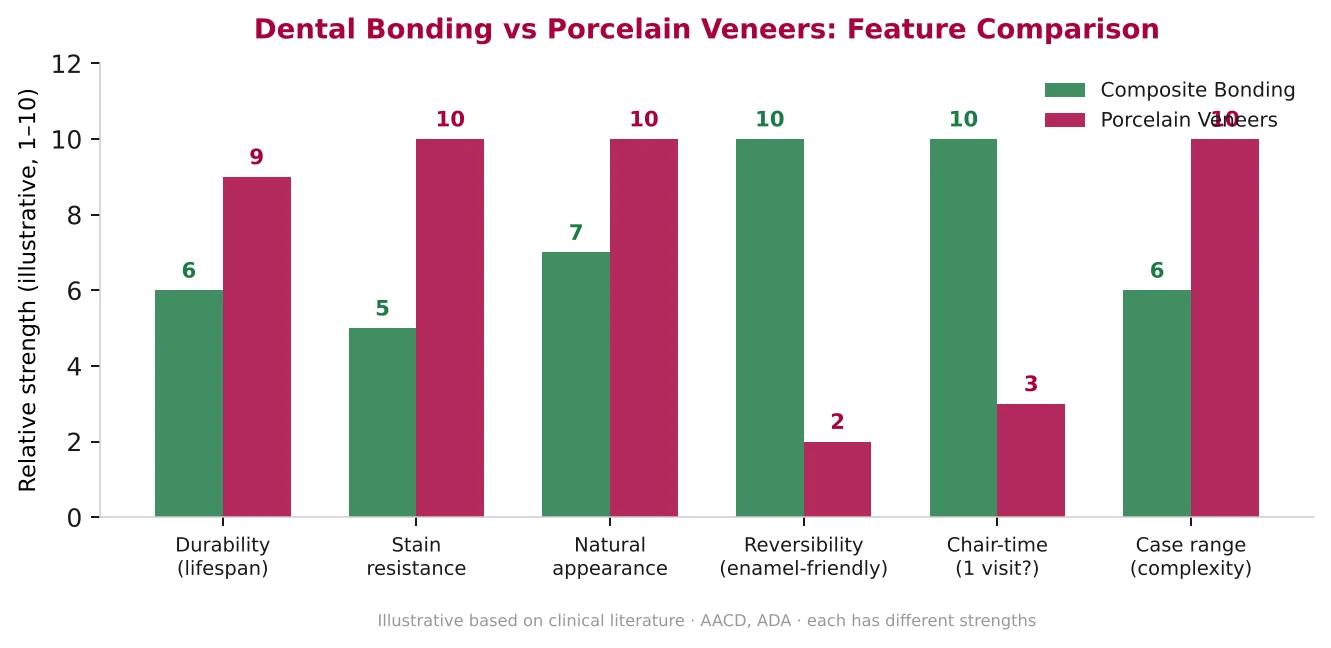
Both treatments change how your teeth look, and both are done by a cosmetic dentist — but they differ in almost every practical respect. Here is the side-by-side.
| Feature | Dental bonding | Porcelain veneers |
|---|---|---|
| Material | Composite resin | Porcelain (lithium disilicate) |
| Typical cost per tooth | $100–$600 | $925–$2,500 |
| Full smile (6 teeth) | $600–$3,600 | $5,550–$15,000 |
| Chair time | 1 visit (30–60 min per tooth) | 2–3 visits over 2–3 weeks |
| Enamel reduction | None (reversible) | About 0.5mm (permanent) |
| Lifespan | 3–10 years | 10–15 years, often 20+ |
| Stain resistance | Moderate | Excellent |
| Best for | Small fixes, chip repair, tighter budget | Full smile makeover, long-term result |
| Available at Hampton | Yes | Yes |
What is dental bonding?
Dental bonding is a cosmetic procedure where tooth-colored composite resin is applied to your tooth, shaped by hand, and hardened with a UV curing light. It is a conservative, same-day fix for a lot of common cosmetic complaints: chipped or cracked teeth, small gaps, minor discoloration that whitening won't shift, teeth that look short or uneven, and roots exposed by gum recession.
The dentist roughens the tooth surface slightly, applies a bonding agent, shapes the composite to match the natural tooth, and cures it with light. Shaping and polishing finish the job. Figure 30 to 60 minutes per tooth, one visit, and in most cases no anesthesia at all. The key advantage is that no enamel is removed — if you change your mind later or want to move to veneers, your natural tooth is intact underneath.
What are porcelain veneers?
Porcelain veneers are thin, custom-made shells of porcelain that cover the front surface of your teeth. They are the stronger answer for full smile makeovers, severe discoloration that whitening cannot correct, misshapen or uneven teeth across several front teeth, permanently chipped or worn teeth, and for anyone who wants one consistent long-term result.
A thin layer of enamel — around 0.5mm — is removed to make room for the veneer. Impressions or a digital scan are taken and temporaries are placed while the permanent veneers are fabricated at a dental lab. At the second visit, the temporaries come off and the permanent veneers are bonded in place. The thing to understand before you start: veneers require that enamel removal and are a permanent commitment. You will have veneers for the rest of your life, though individual ones can be replaced as they wear.
How much does each one cost?
Cost is the clearest difference between the two. These are national averages from ADA and industry data.
| Option | Per tooth | Full smile (6 teeth) |
|---|---|---|
| Composite bonding | $100–$600 | $600–$3,600 |
| Porcelain veneer | $925–$2,500 | $5,550–$15,000 |
On insurance: most cosmetic dental work is not covered, because bonding or veneers done purely for appearance counts as elective. Bonding may be covered when it repairs a cracked tooth and is therefore medically necessary. For patients paying out of pocket, our in-house membership plan starts at $288/year and includes 15% off cosmetic procedures.
Which lasts longer?
Porcelain veneers, by a clear margin. Composite bonding typically lasts 3 to 10 years before it chips, stains, or needs a touch-up. Porcelain veneers typically last 10 to 15 years, and often 20 or more, before they need replacing.
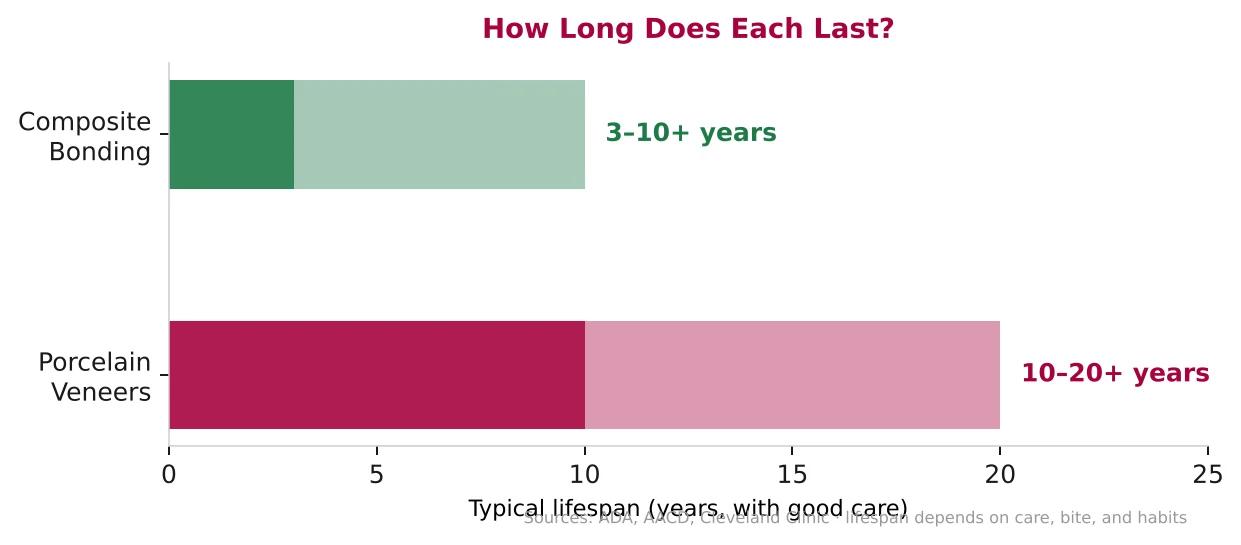
The reason is material: porcelain is harder, non-porous, and far more stain-resistant than composite resin. Placement matters too — bonding on front teeth that don't take chewing force outlasts bonding on back teeth. So do habits. Grinding, chewing ice, or biting your nails will shorten the life of either option. For more detail, see our guide on how long veneers last.
Which fits which situation?
The right answer depends entirely on what you are treating. Here is how a cosmetic dentist actually thinks about it, case by case.
Chipped or broken tooth
Bonding wins for most chipped teeth. A composite repair takes 30 to 60 minutes, costs $100 to $600, matches your natural tooth colour, and removes no enamel. For large structural chips or broken teeth where significant tooth structure is gone, a veneer or a crown is the better choice.
Small gaps between teeth
Bonding often wins for one or two small gaps — composite can be added to the sides of adjacent teeth and close the space in a single visit. For wider gaps, or when several need closing across the smile, veneers give a more uniform result. And there is a third option worth naming: if the underlying alignment is what should really move, clear aligners address the cause rather than masking it.
Discolored teeth that whitening can't fix
Veneers usually win here. Deep intrinsic discoloration — from tetracycline, dental trauma, or genetics — does not respond to professional whitening. Porcelain covers it completely and does not stain over time. Bonding can mask discoloration too, but the composite itself is more likely to stain within a few years.
Full smile makeover
Veneers almost always win for a comprehensive change. When you are treating six or more front teeth for a uniform look — matched shape, colour, and length — porcelain gives the most predictable and longest-lasting result. The upfront cost is higher, but you are not revisiting it for 10 to 20 years. For how the whole plan comes together, see our smile makeover guide.
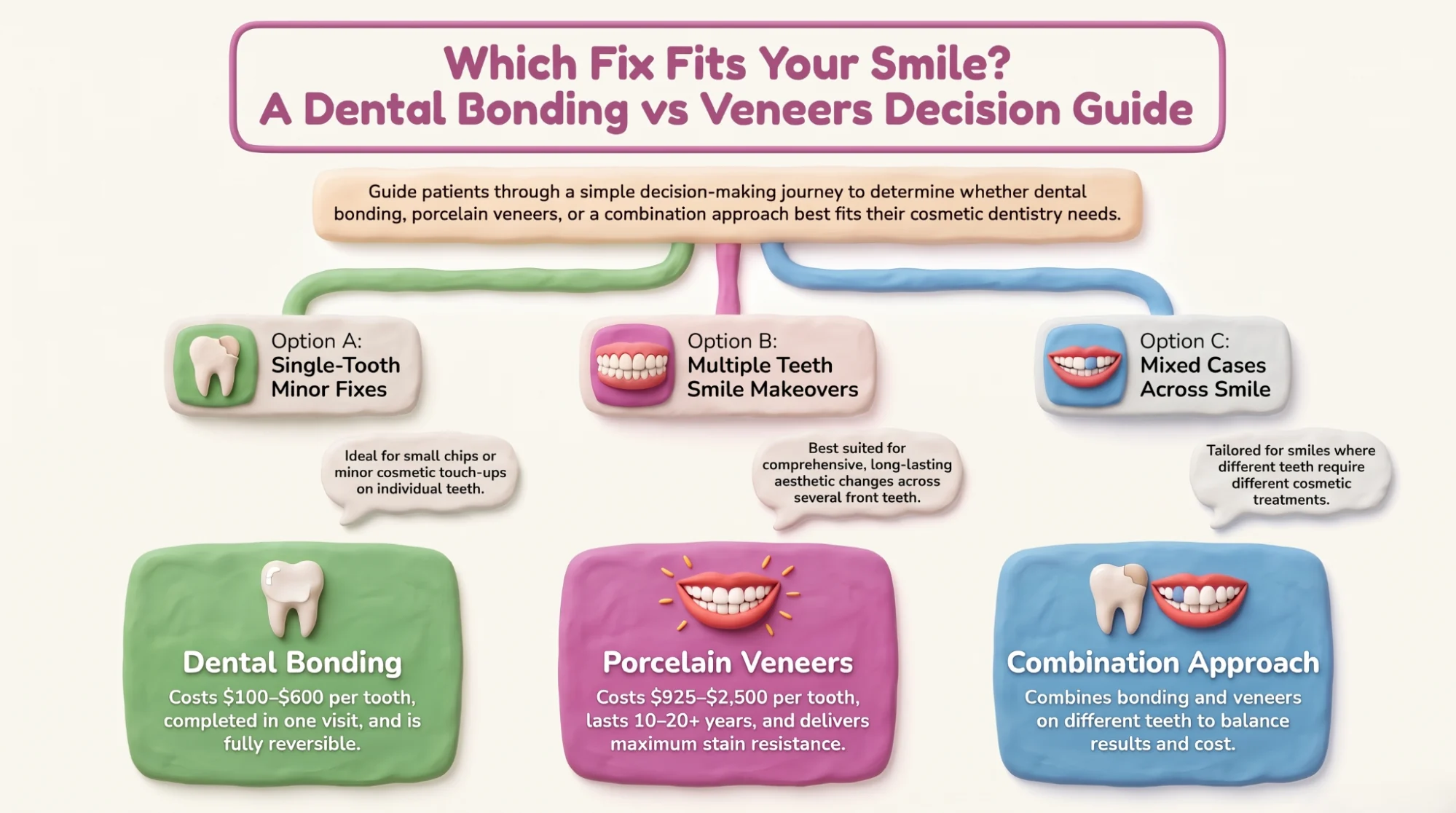
Can you mix bonding and veneers on different teeth?
Yes — and it is more common than people expect, often as the smartest plan rather than a compromise.
- Veneers on the two front teeth that show most when you smile, bonding on the side teeth that draw less attention
- Veneers on severely discolored teeth, bonding on teeth that only have minor chips
- Veneers on the upper front teeth that show when smiling, bonding on the less visible lower teeth
Your cosmetic dentist plans this at the consultation so shade, shape, and finish blend naturally. The goal is one coherent smile, not a patchwork.
Do veneers damage your teeth?
Porcelain veneers require minor enamel reduction, typically about 0.5mm per tooth — roughly the thickness of a fingernail. That enamel is permanently removed to make room for the veneer so it sits flush with your bite.
Is that damage? Technically yes: your natural tooth structure is permanently altered. In practice, a properly placed veneer protects the tooth underneath and functions like a natural one for 10 to 20 years. The honest framing is less about damage and more about commitment — you will have veneers, or something covering the prepared tooth, for the rest of your life.
How your Southampton dentist decides between the two
Dr. Keyur Dudhat performs both bonding and veneers at Hampton Family Dental. Here is the framework behind a cosmetic consultation.
- Smile assessment — photos, bite evaluation, and a tooth-by-tooth review of what is bothering you against what is clinically there
- Case classification — single tooth, several teeth, or a full smile? Chip, discoloration, gap, or shape? Each points somewhere different
- Projected result preview — digital imaging or a wax mock-up shows what each option would look like before you commit to anything
- Honest recommendation — because both procedures are offered here, the advice follows your case rather than what the office happens to perform
- Your decision — with a full written estimate in hand, you weigh cost, longevity, chair time, and reversibility yourself
Not sure which one fits your smile?
Book a cosmetic consultation with Dr. Dudhat. You'll see a projected result and a written estimate for both options before you decide anything.