
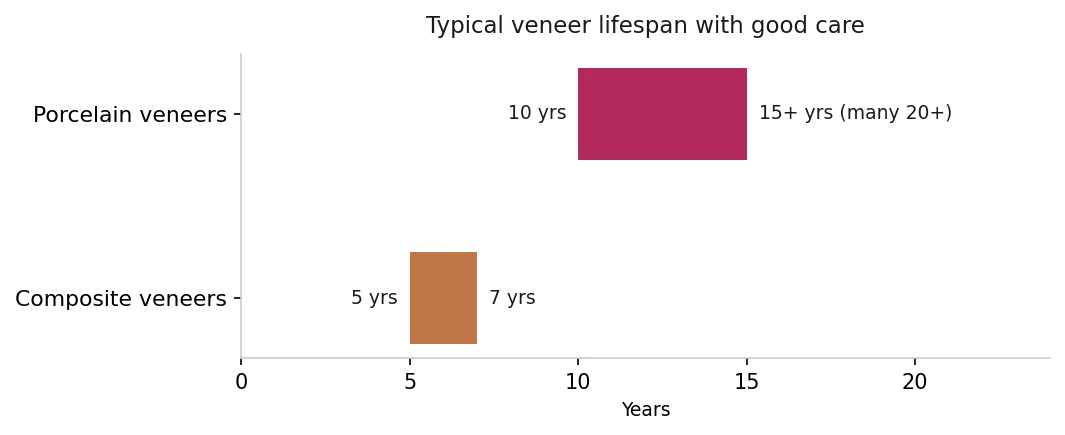
With good care, porcelain veneers typically last 10 to 15 years — and often 20 or more. Composite veneers usually last about 5 to 7 years. How long yours last comes down to your oral hygiene, your bite, and habits like grinding or nail-biting. Porcelain costs about $900–$2,500 per tooth. At Hampton Family Dental in Southampton, PA, Dr. Dudhat plans veneers built to last.
The short version
- Porcelain veneers typically last 10–15 years, and often 20+, with good care; composite lasts about 5–7 years.
- The biggest factors are your daily oral hygiene, your bite, and habits like grinding or biting hard objects.
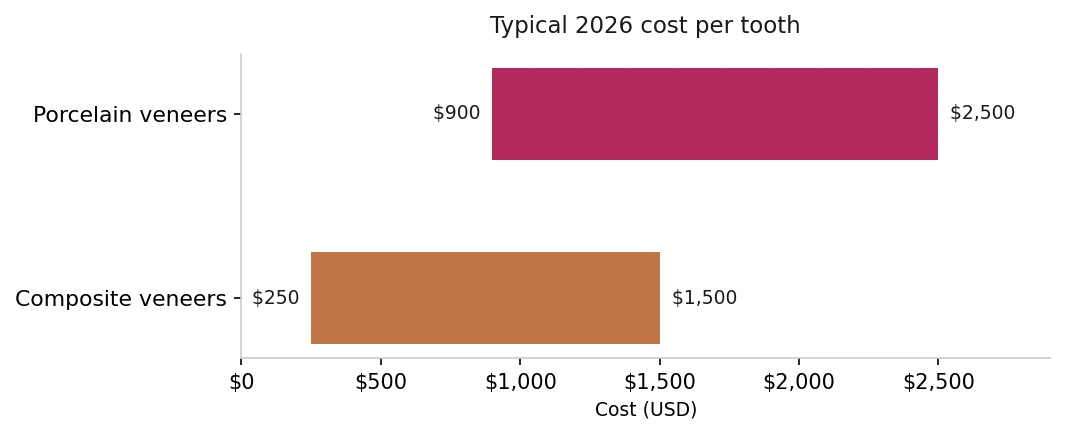
- Porcelain costs about $900–$2,500 per tooth; a full set of 6–8 runs roughly $9,000–$24,000.
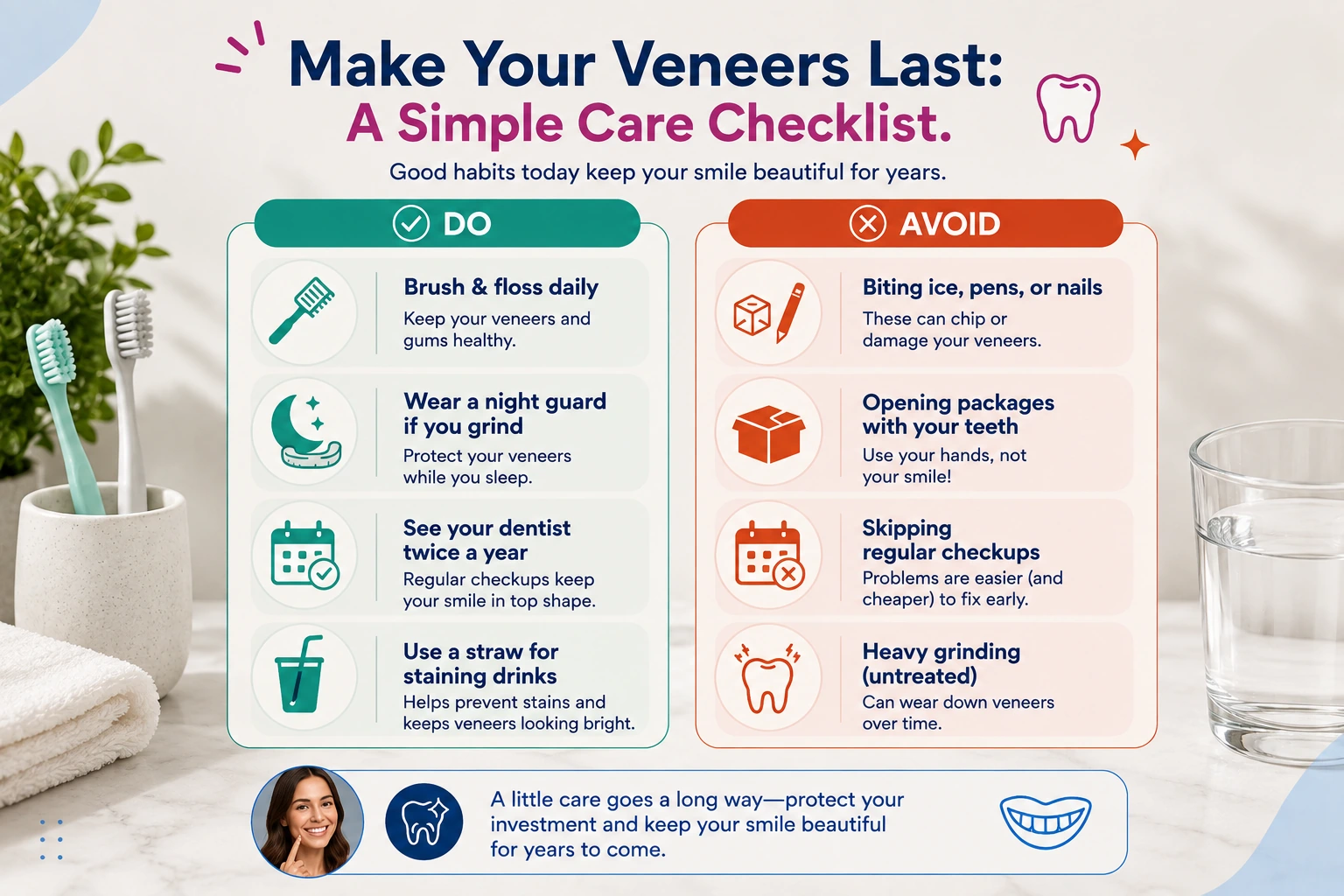
- A night guard, regular checkups, and skipping ice and nail-biting can add years to your veneers.
- Veneers are a long-term commitment — a little enamel is reshaped, so the teeth always need a covering afterward.
How long do veneers really last?
Porcelain veneers typically last 10 to 15 years, and often 20 or more, with good care. That's not just a marketing line — clinical research following feldspathic porcelain veneers bonded to enamel found roughly a 96% survival rate at 21 years, and a 2018 review found the vast majority lasted well past 10 years. You can see the porcelain veneers at Hampton Family Dental for how we plan them to last.
Porcelain vs. composite: how the material changes the answer
The material you choose is the single biggest driver of lifespan. Here's the honest comparison:
| Porcelain veneers | Composite veneers | |
|---|---|---|
| Lifespan | 10–15 years (often 20+) | About 5–7 years |
| Cost per tooth | $900–$2,500 | $250–$1,500 |
| Stain resistance | Excellent | Good, stains sooner |
| Visits | 2–3 visits (lab-made) | Often 1 visit (chairside) |
| Look | Natural translucency | Very good, less translucent |
| Best for | Long-term, whole-smile results | Budget, quick fixes, single teeth |
Porcelain wins on durability and its stain-resistant finish; composite wins on cost and speed. Both can look beautiful — it's a trade-off, not a right-or-wrong. If stain resistance is what's drawing you in, it's worth reading how professional whitening compares to store-bought kits first, since a simpler route sometimes gets you most of the way. You can also browse other cosmetic options.
What makes veneers last longer (or wear out sooner)?
Beyond the material, four things decide whether your veneers reach the top of that range or the bottom:
- Your oral hygiene — brushing and flossing protect the bond and the tooth underneath.
- Your bite and grinding — bruxism puts stress no veneer is built to take long-term.
- Your habits — biting ice, pens, or nails, or using teeth as tools, chips veneers early.
- The quality of the placement — an experienced dentist and a good bond make a real difference.
That last point is why it's worth choosing carefully — how our veneers are made matters as much as the porcelain itself.
How to care for your veneers
The good news: caring for veneers is mostly caring for your teeth. Brush and floss daily, keep your regular checkups, and if you grind your teeth at night, a custom night guard is one of the smartest things you can do — the American Dental Association notes that grinding is a leading cause of early cosmetic wear. Skip biting ice and nails, and use a straw for coffee, tea, or wine to keep everything bright.
How much do veneers cost — and are they worth it?
Porcelain veneers cost about $900 to $2,500 per tooth, with a national average around $1,765 per the American Academy of Cosmetic Dentistry; a full set of 6 to 8 front teeth typically runs $9,000 to $24,000. Here's the honest way to think about it: spread over a 15-year lifespan, a $2,000 veneer works out to about $133 a year. Veneers are cosmetic, so insurance doesn't cover them — but our financing and current offers, including CareCredit, make the investment easier to manage.
Are veneers a permanent commitment?
Yes — and this is the honest part every buyer should hear before they commit. To place veneers, a dentist reshapes a thin layer of enamel, and enamel doesn't grow back. That means once you have veneers, your teeth will always need some form of covering — you'll replace veneers over the years rather than go back to bare teeth. That's not a drawback so much as a decision to make with your eyes open: veneers are a long-term investment in your smile, not a temporary look.
Getting veneers that last in Southampton
Because placement quality is one of the biggest factors in how long veneers last, who does them matters. Dr. Keyur Dudhat plans each case with digital imaging and matches shade and shape so the result looks natural, not obvious — and is built to hold up. If you're weighing whether veneers are right for you, book a veneers consultation and we'll give you an honest answer.
Thinking about veneers?
Call (215) 357-2224 or book a consultation — we'll talk through material, cost, and what your veneers would realistically need over the years.