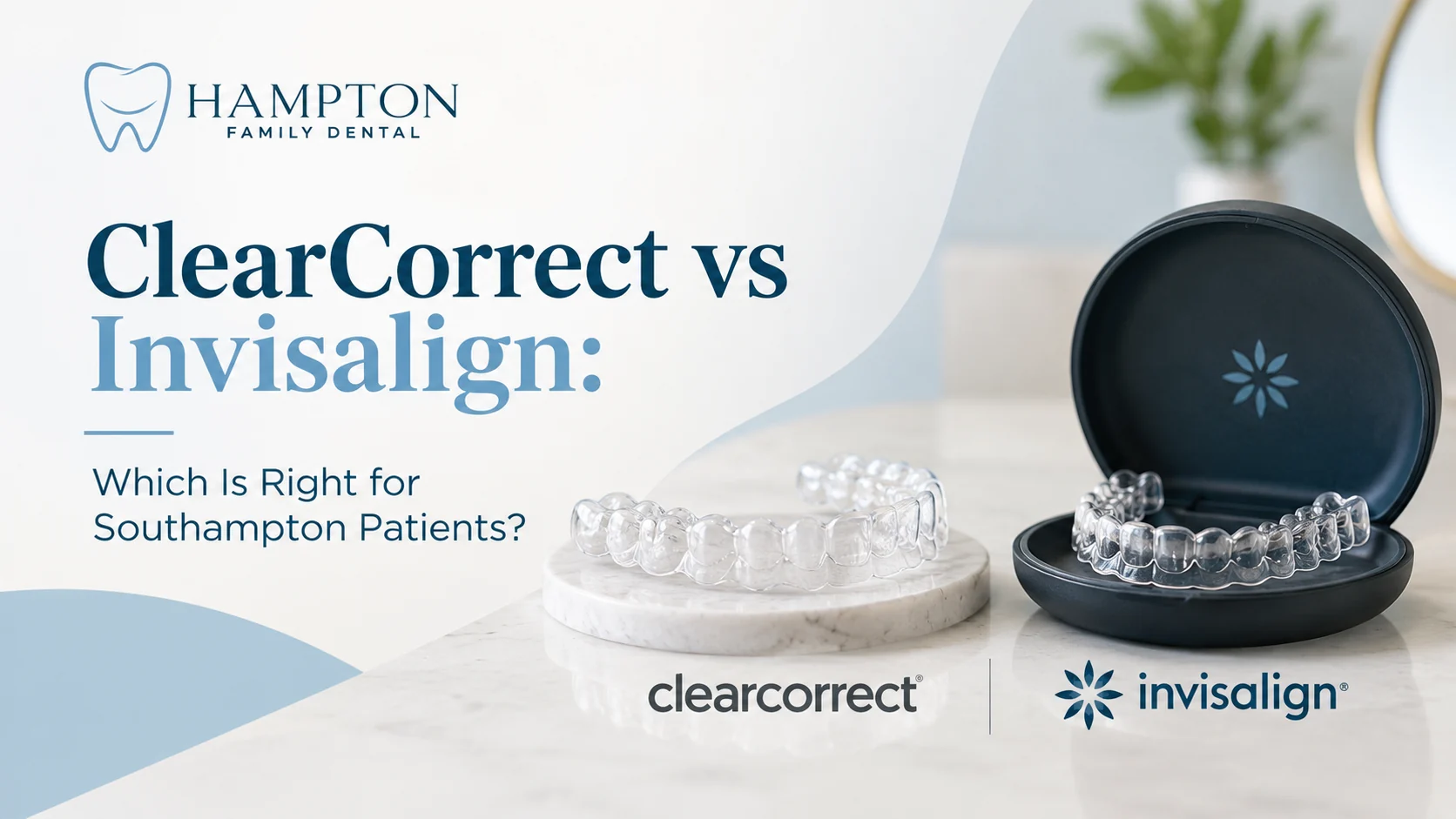
ClearCorrect and Invisalign both use clear plastic trays to straighten teeth, and both are FDA-cleared and clinically effective. The main differences: ClearCorrect is typically less expensive (around $3,000–$5,500 nationally versus $4,000–$7,500 for Invisalign), while Invisalign has a broader published case range for very complex orthodontic needs. At Hampton Family Dental in Southampton, PA, Dr. Keyur Dudhat offers ClearCorrect at $5,000 (regularly $6,500) with a free consultation and 3D digital scan.
The short version
- Both ClearCorrect and Invisalign are FDA-cleared clear aligner systems. They work the same way and produce similar outcomes for most cases.
- Nationally, ClearCorrect typically costs $3,000–$5,500 and Invisalign $4,000–$7,500. Case complexity, your dentist, and insurance all move the final number.
- Invisalign has a broader published case range and may be preferred for very complex bite correction. For most mild-to-moderate cases, ClearCorrect is clinically equivalent and costs less.
- Treatment time is similar for both: 6–12 months for mild cases, 12–24 months for complex ones. Daily wear time matters more than the brand.
- At Hampton Family Dental, ClearCorrect is currently $5,000 (regularly $6,500) with a free consultation and 3D-imaging-guided planning from Dr. Dudhat.
ClearCorrect vs Invisalign at a glance
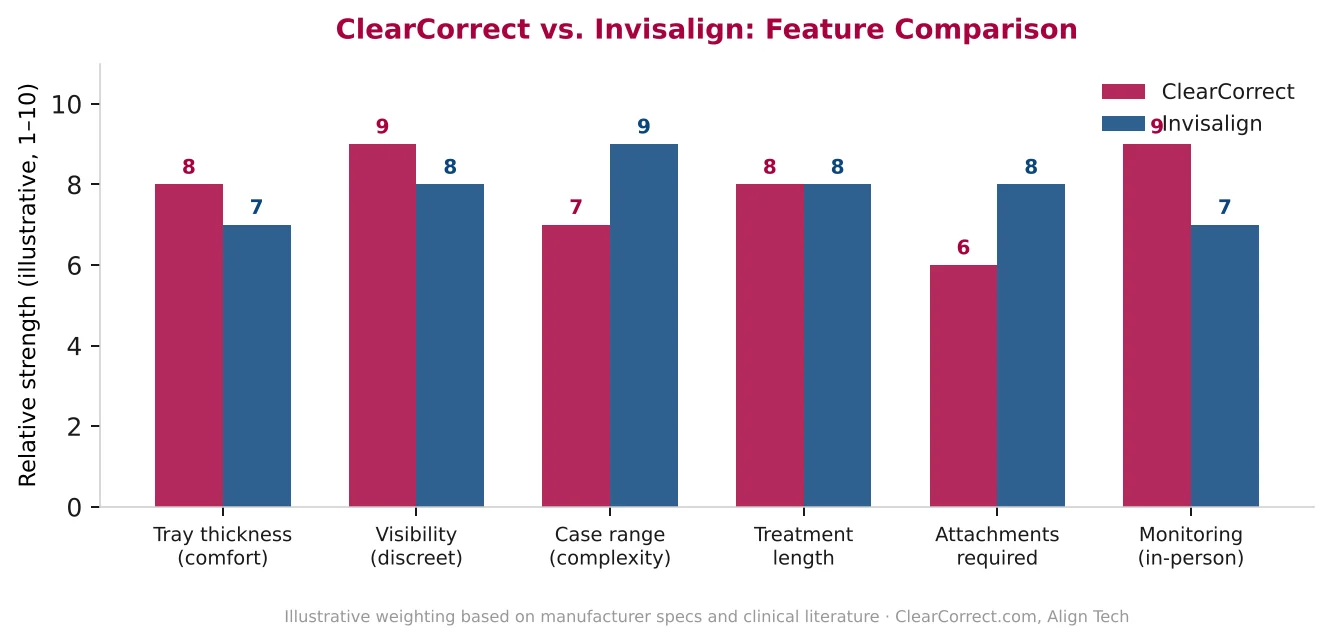
Both systems are FDA-cleared Class II medical devices made by established manufacturers — ClearCorrect by the Straumann Group, Invisalign by Align Technology. Here is how they compare on the factors patients actually ask about.
| Feature | ClearCorrect | Invisalign |
|---|---|---|
| Manufacturer | Straumann Group | Align Technology |
| FDA cleared | Yes | Yes |
| Material | ClearQuartz tri-layer | SmartTrack |
| Typical cost (national) | $3,000–$5,500 | $4,000–$7,500 |
| Case range | Mild to moderate; some complex | Mild to very complex (broader) |
| Treatment duration | 6–20 months (case-dependent) | 6–24 months (case-dependent) |
| Tray trim | Thinner, trimmed to the gumline | Slightly thicker, standard scalloped |
| Attachments | Fewer typically needed | More attachment variety |
| Daily wear time | 20–22 hours/day | 20–22 hours/day |
| Available at Hampton | Yes — $5,000 (regularly $6,500) | Available at select local practices |
How much do ClearCorrect and Invisalign cost?
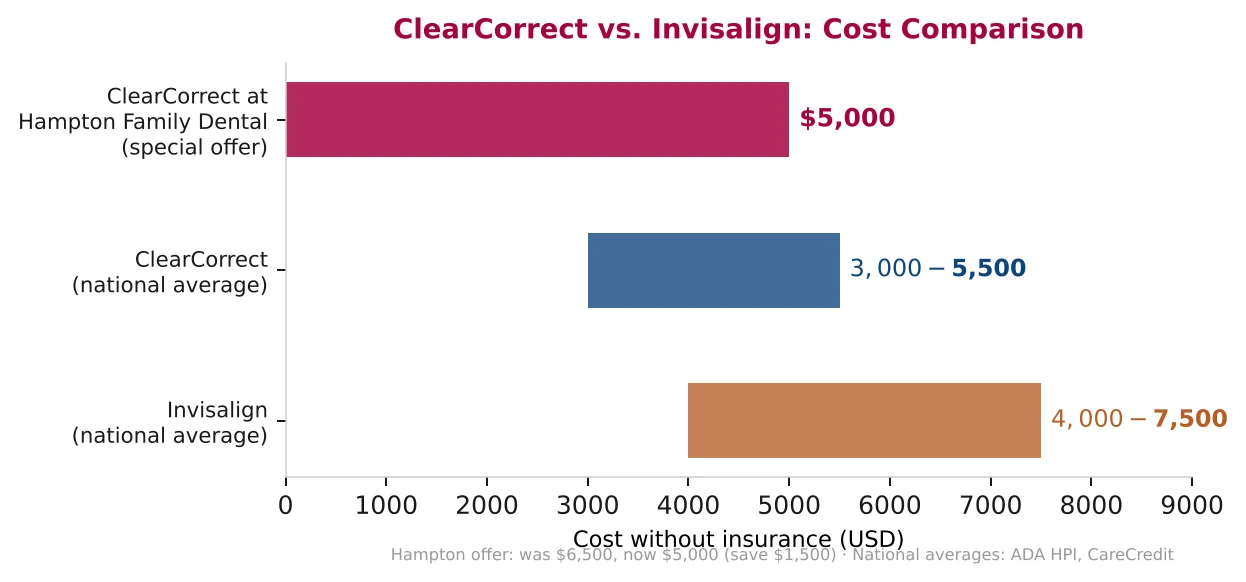
Clear aligner costs vary with case complexity, your dentist's experience, and your location — but the two systems sit in different typical ranges. ClearCorrect runs $3,000 to $5,500 nationally for most cases, with some complex cases going higher. Invisalign runs $4,000 to $7,500; short-term express cases can be lower, and comprehensive treatment can exceed $8,000. Both ranges reflect published ADA Health Policy Institute and CareCredit data. A short mild-crowding case sits at the low end; a long complex case at the high end.
ClearCorrect cost at Hampton Family Dental
At Hampton Family Dental in Southampton, PA, ClearCorrect clear aligners are currently offered at $5,000, regularly $6,500. That includes a free consultation and smile assessment with Dr. Keyur Dudhat, a 3D digital scan with a projected result preview before you commit, your complete ClearCorrect treatment, and all follow-up visits and refinements. Flexible monthly payment plans are available and most PPO insurances are accepted.
How long does treatment take with each?
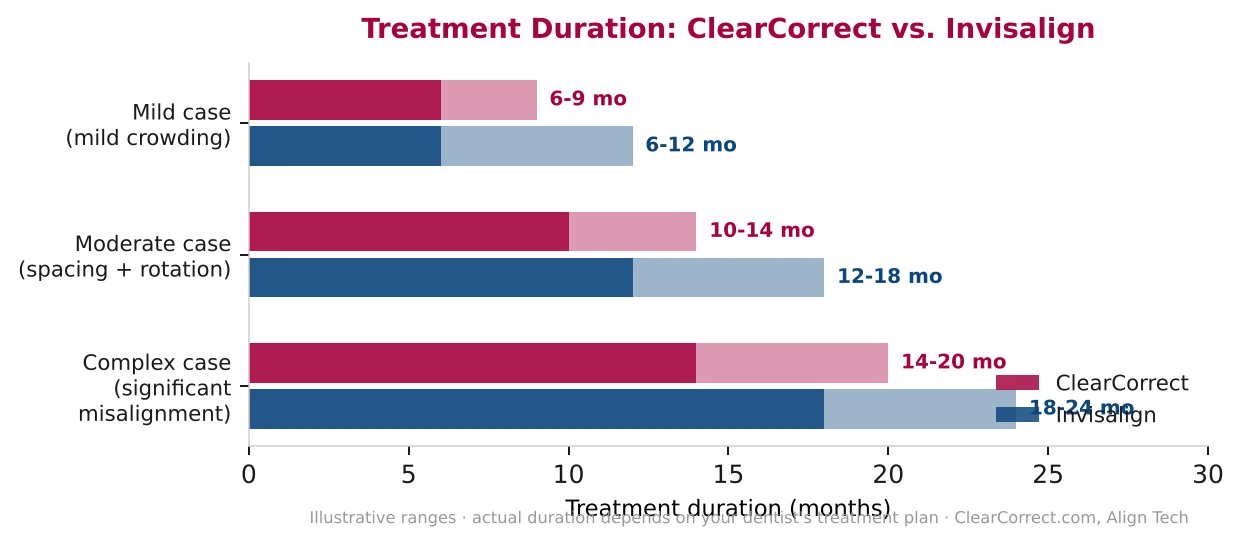
Treatment duration depends mostly on case complexity, not on the brand of aligner. Mild cases — small crowding or minor spacing — typically take 6 to 12 months with either system. Moderate cases, meaning spacing with rotation or mild bite correction, take 10 to 18 months. Complex cases involving significant misalignment or bite correction take 14 to 24 months.
Within each category, ClearCorrect averages run slightly shorter at the mild end, and Invisalign averages slightly longer at the complex end — largely because Invisalign is more often used for the hardest cases in the first place. What matters far more than the brand is daily wear time: both systems need 20 to 22 hours a day to stay on schedule.
Which is better for complex cases?
For straightforward crowding, spacing, and mild bite issues, both systems work equally well. The differences show up at the complex end.
Invisalign has advantages when significant bite correction is needed (overbite, crossbite, open bite), when large tooth movements are required for impacted or severely rotated teeth, when multiple attachments are needed to control specific movements, or when the case would otherwise call for braces but you want a clear option.
ClearCorrect has advantages when cost is a significant factor and insurance coverage is limited, when the case is mild to moderate — which most adult cases are — when you prefer a thinner, less bulky tray, or when you would rather have fewer attachments bonded to your teeth.
Your dentist's 3D scan and treatment plan show which one fits your case. At Hampton Family Dental, Dr. Dudhat uses 3D-imaging-guided planning for every clear aligner case, so you see your projected result before committing to either system.
Are ClearCorrect aligners more comfortable than Invisalign?
Comfort is individual, but there are real structural differences. ClearCorrect trays use a thinner tri-layer material (ClearQuartz) and are typically trimmed closer to the gumline — many patients report they feel slightly less bulky and are easier to take in and out. Invisalign trays use SmartTrack material with a scalloped trim; some patients find the slightly thicker material more noticeable at first, though it is not a dramatic difference.
Both systems cause some soreness during the first 24 to 72 hours of each new tray. That is normal and means the aligners are doing their job. By tray five or six, most people have adjusted and the discomfort fades quickly with each change.
Does insurance cover ClearCorrect and Invisalign?
Many dental plans with orthodontic benefits cover a portion of clear aligner treatment — typically $1,000 to $3,000 toward either system. Coverage varies widely: some plans carry a lifetime orthodontic maximum of $1,500–$3,000, some cover adults while others limit orthodontic benefits to under-19s, and many plans don't distinguish between brands at all because both qualify as medically necessary orthodontic treatment.
Hampton Family Dental will verify your specific benefits before treatment and apply any coverage to the $5,000 ClearCorrect price. For patients without aligner coverage, our in-house membership plan starts at $288/year and includes 15% off most procedures and 10% off orthodontics and implants — ask whether it can be combined with the current ClearCorrect offer.
Not sure which aligner fits your case?
Book a free aligner consultation and 3D scan with Dr. Dudhat. You'll see your projected result and a written cost before you commit to anything.
How does your Southampton dentist choose between the two?
Dr. Dudhat uses 3D-imaging-guided planning for every clear aligner case at Hampton Family Dental. Here is the framework behind the recommendation.
- 3D scan and bite analysis. A digital scan shows the exact position of every tooth and the bite relationship — no impression trays, no gag reflex, no guesswork.
- Case classification. The scan classifies your case as mild, moderate, or complex based on crowding, spacing, rotation, and bite correction needs.
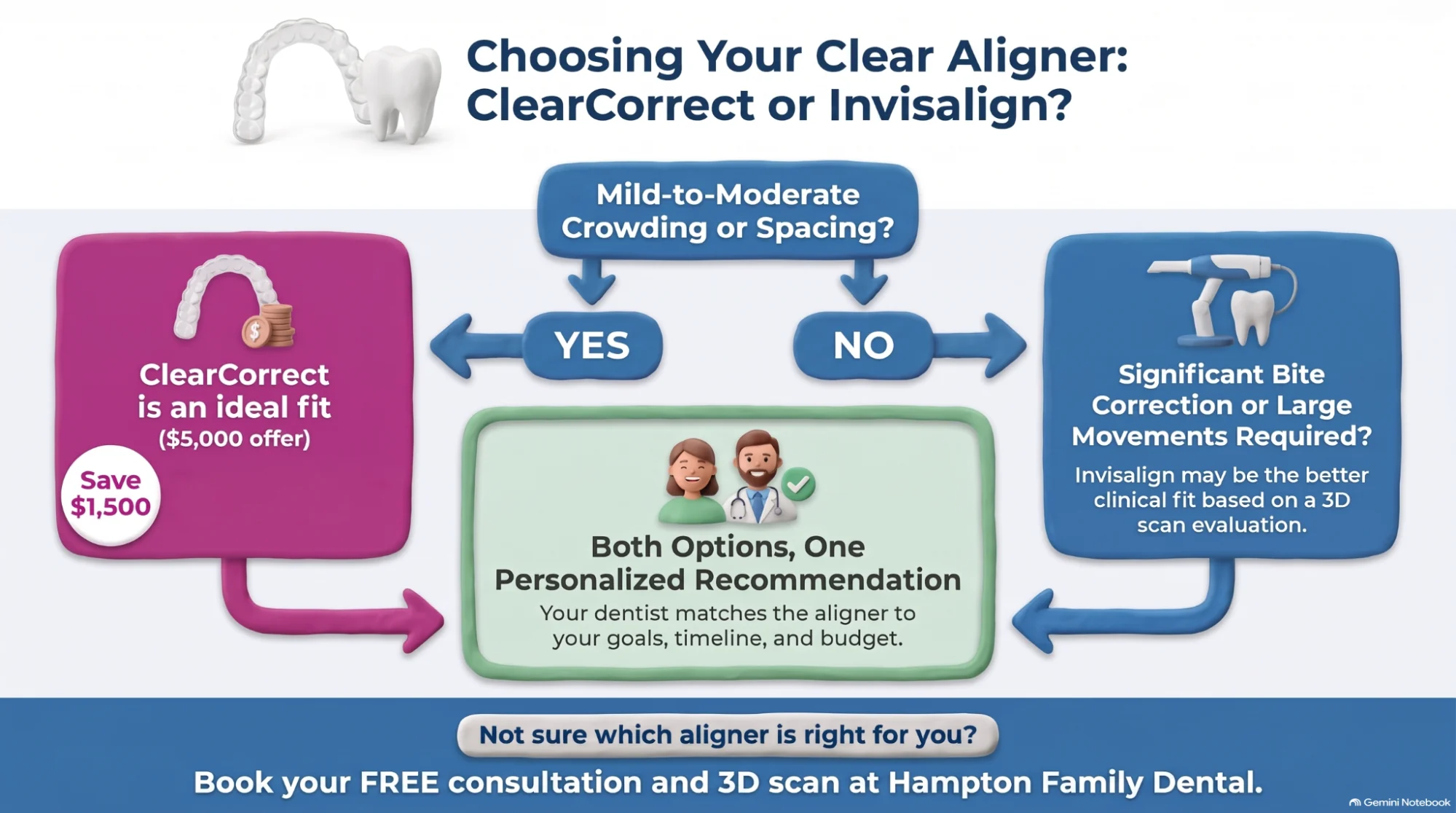
- System match. For most mild-to-moderate cases, ClearCorrect is clinically appropriate and better value. For significant bite correction or very complex movements, Invisalign may be the better fit.
- Projected result preview. You see what your smile will look like at the end of treatment before you commit — timeline, number of trays, and total cost shown upfront.
- Your decision. With the plan in hand, you choose based on your priorities: cost, comfort, timeline. The recommendation is clinical; the choice is yours.
If you are also weighing clear aligners against traditional braces, see our Invisalign vs. braces comparison. You can also read more about ClearCorrect at Hampton Family Dental or about Invisalign treatment here.