
Both straighten teeth well. Invisalign uses clear, removable aligners and is nearly invisible, usually taking 8–12 months and costing $3,500–$8,000. Traditional braces are fixed, handle complex cases best, take 18–24 months, and cost $3,000–$7,000. Invisalign suits appearance-conscious adults with mild-to-moderate cases; braces suit complex bites. At Hampton Family Dental in Southampton, PA, Dr. Dudhat helps you choose what fits your smile.
The short version
- Cost is close: braces $3,000–$7,000, Invisalign $3,500–$8,000 — the 2026 gap is about $175.
- Invisalign is usually faster (8–12 months) than braces (18–24 months) for similar cases.
- Invisalign is nearly invisible and removable; braces are fixed and better for complex bites.
- Insurance usually treats both the same — around 50% up to a lifetime orthodontic maximum.
- The right choice depends on your case, not the ads — a quick exam tells you which fits.
Invisalign vs. braces at a glance
Both are proven ways to straighten teeth — the American Dental Association recognizes clear aligners and braces as effective orthodontic options. Here's how they compare:
| Invisalign | Traditional braces | |
|---|---|---|
| Typical cost (2026) | $3,500 – $8,000 | $3,000 – $7,000 |
| Treatment time | 8 – 12 months | 18 – 24 months |
| Appearance | Clear, nearly invisible | Visible metal or ceramic |
| Removable? | Yes — for meals & brushing | No — fixed in place |
| Comfort | No wires; mild pressure | Wires can irritate |
| Best for | Mild-to-moderate cases | Complex bite problems |
| Discipline needed | High — wear 20–22 hrs/day | Low — always working |
How much do Invisalign and braces cost?
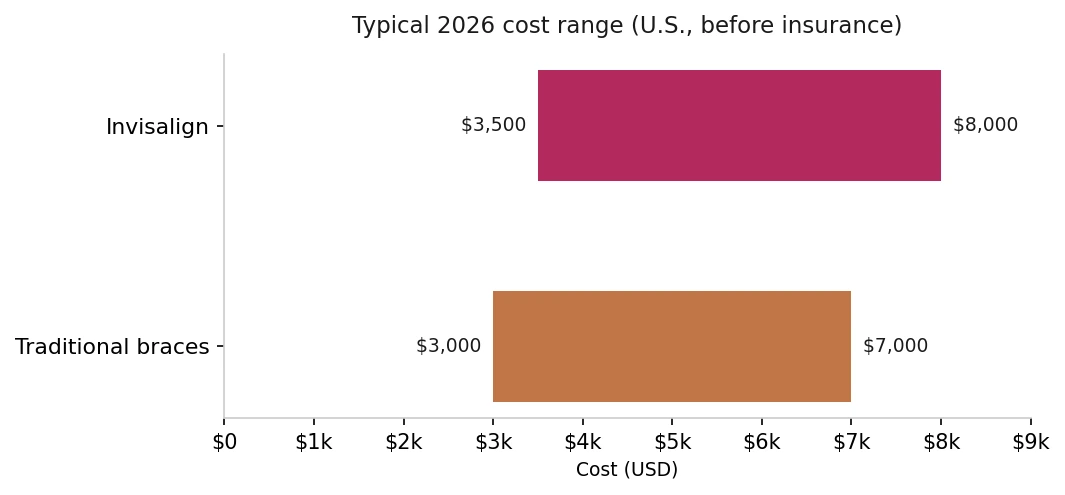
Braces are usually a little cheaper — about $3,000 to $7,000, versus $3,500 to $8,000 for Invisalign at Hampton Family Dental. Here's the surprise: in 2026 that gap has narrowed to roughly $175 nationally, so cost is rarely the deciding factor anymore. Your final price depends on how complex your case is and how long treatment takes — not just which system you pick.
How long does each treatment take?
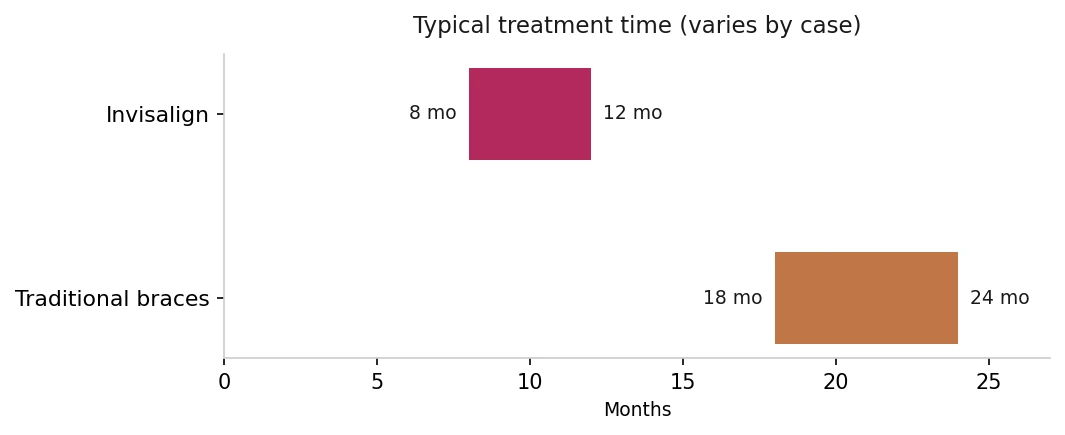
Invisalign is often faster. For comparable cases it usually takes 8 to 12 months, while braces typically run 18 to 24 months. That said, complex bite issues can extend either one. You can see how our Invisalign treatment works for a sense of the timeline, from the first scan to your final aligner.
Which is more comfortable — and does Invisalign hurt?
Most people feel mild pressure for a day or two after switching to a new aligner, then it fades — that pressure means it's working. Because Invisalign has no wires or brackets, it usually causes less irritation to your cheeks and lips than braces do. Braces aren't painful either, but the wires can occasionally rub. Neither should ever be truly painful; if something hurts sharply, that's a quick office visit, not normal.
Which works better for your case?
For mild to moderate crowding, spacing, or a slightly off bite, Invisalign works just as well as braces and often finishes sooner. It's a great fit for appearance-conscious adults and responsible teens who'll keep the aligners in. If straightening isn't your only goal, it's worth looking at other ways to improve your smile at the same visit.
When braces are the better choice
We'll be honest — braces are sometimes the smarter pick. For complex bite problems, significant rotation, or moving teeth long distances, fixed braces give the dentist more precise control, and the American Association of Orthodontists notes that some cases simply respond better to brackets. Braces are also the safer bet for a younger child who might lose removable trays. A quick exam tells you which camp you're in — guessing from a chart won't.
Does insurance cover Invisalign or braces?
Good news: most dental plans treat the two about the same, usually covering around 50% up to a lifetime orthodontic maximum. Both also qualify for FSA and HSA pre-tax dollars. Coverage varies by plan, so we check your insurance benefits up front, and our membership plan and current offers can help with what's left.
So which should you choose?
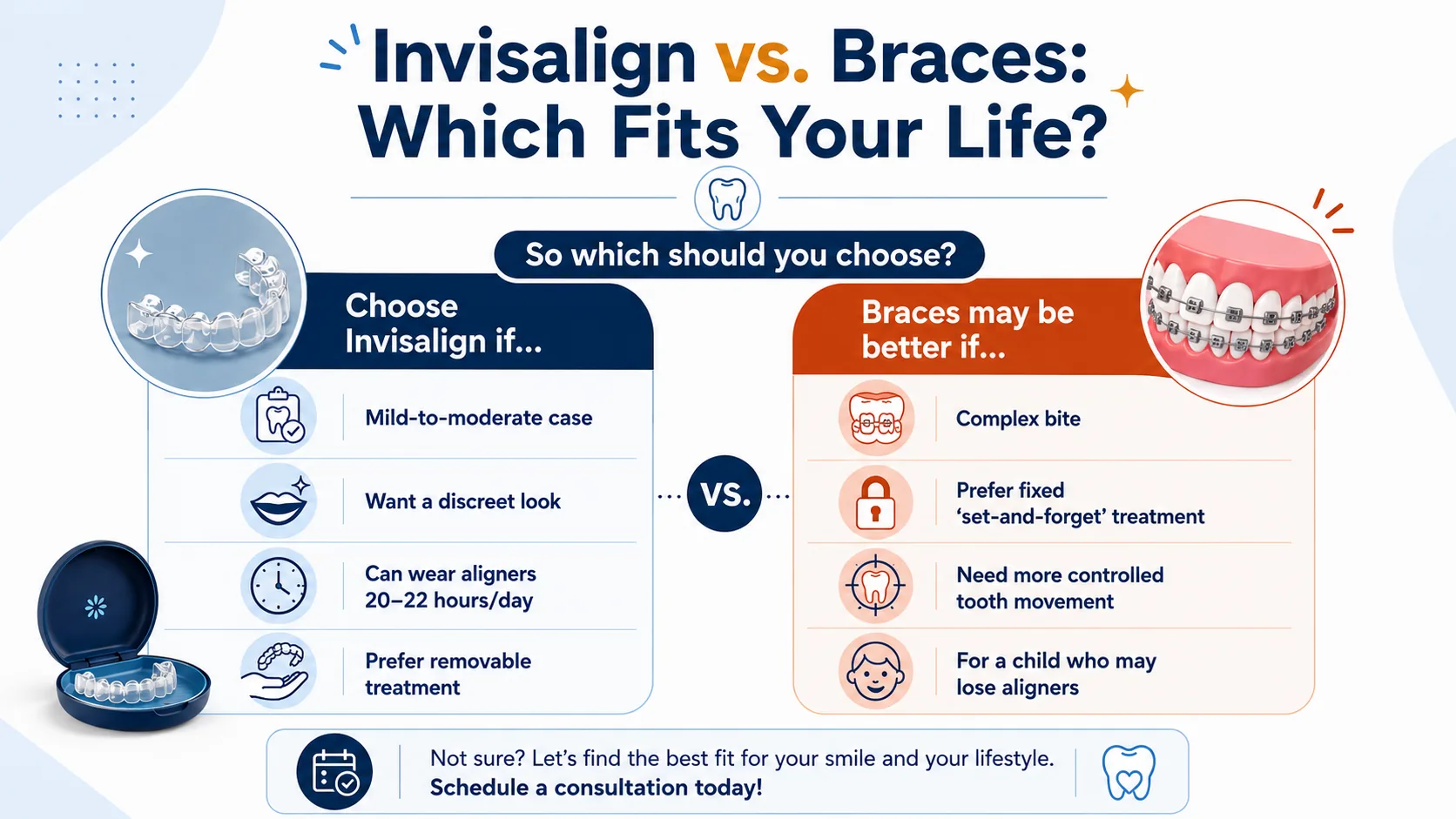
Choose Invisalign if you want a discreet, removable option, have a mild-to-moderate case, and you're disciplined about wearing it 20–22 hours a day. Lean toward braces if your case is complex, you'd rather set it and forget it, or it's for a younger child. For most appearance-motivated adults in Bucks County, Invisalign checks the boxes — but the only way to know for sure is a look at your actual teeth.
Straightening your smile in Southampton
One nice advantage of choosing us: you can straighten your smile with Dr. Keyur Dudhat right here as part of your regular dental care — no separate referral to a third-party orthodontist. Dr. Dudhat maps your treatment with a digital scan so you can preview your new smile before you start. Curious which option fits you? Book an Invisalign consultation and we'll give you a straight answer.
See which option fits your smile.
Call us or book a consultation — a quick exam and digital scan tell you which option suits your teeth, not a chart.