

Most adults do well seeing a dentist twice a year, but that's a baseline — not a hard rule. The American Dental Association now recommends a schedule based on your individual risk. Low-risk people with healthy gums may be fine once a year; higher-risk patients (gum disease, diabetes, smoking, pregnancy) often need every 3–4 months. The best answer comes from your dentist after a look at your mouth.
The short version
- “Twice a year” is a baseline for average-risk adults — not a universal rule for everyone.
- The ADA now recommends a visit schedule based on your individual risk, not a fixed six months.
- Low-risk people with healthy gums and no recent cavities may be fine with once-a-year visits.
- Higher-risk patients — gum disease, diabetes, smokers, pregnancy, dry mouth — often need every 3–4 months.
- Checkups catch problems early, when they're smaller, cheaper, and easier to treat — that's the real point.
Where did “twice a year” come from?
Almost everyone can recite it: go to the dentist every six months. But here's something most people don't know — that number was never a strict clinical law. It took hold in the mid-1900s, shaped as much by toothpaste advertising and insurance patterns as by hard science. It's a sensible baseline for an average person, the way “eight glasses of water a day” is a rough rule of thumb rather than a medical prescription. Useful, but not the whole story.
How often should YOU go? It depends on your risk
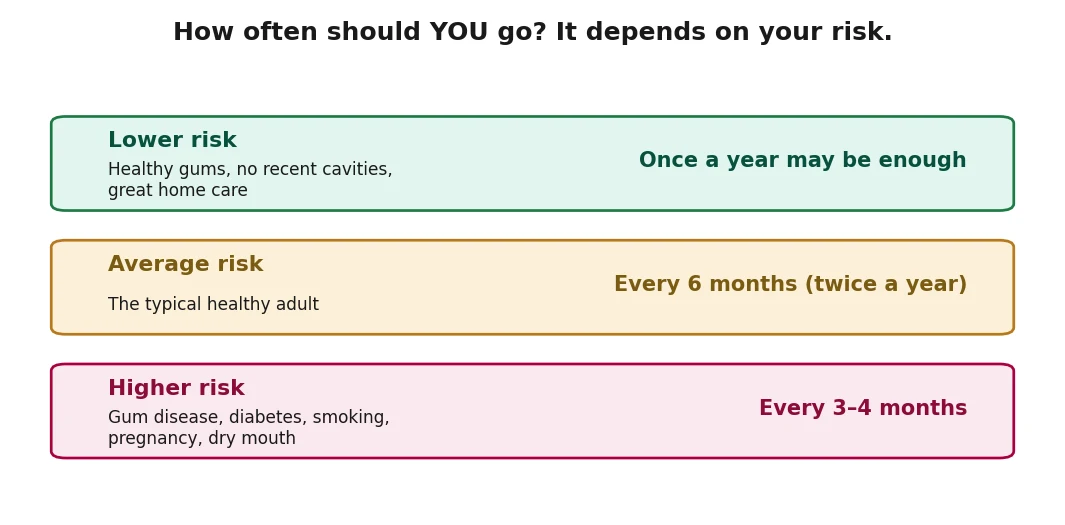
Today the American Dental Association no longer gives a one-size-fits-all number. Instead, it recommends a schedule set by your individual risk — your history of cavities and gum disease, your health, and your habits. Here's how that shakes out for most people:
| Your risk level | Typical visit frequency | Who this is |
|---|---|---|
| Lower risk | Once a year may be enough | Healthy gums, no recent cavities, excellent home care |
| Average risk | Every six months | Most healthy adults — the familiar default |
| Higher risk | Every three to four months | Gum disease, diabetes, dry mouth, smokers, pregnancy |
Lower-risk: once a year may be enough
If you have healthy gums, no recent cavities, and excellent brushing and flossing habits, you may do just fine with a checkup once a year. A large research review even found limited evidence that six-month cleanings beat longer intervals for genuinely low-risk people. Your dentist should confirm you're in this group — but if you are, there's no need for guilt about not going more.
Average-risk: every six months
For most healthy adults, the familiar six-month rhythm is still a smart default. Twice-yearly professional cleaning removes the tartar you can't reach at home, and regular exams catch small issues before they grow. It's the sweet spot for the average mouth — enough to stay ahead of trouble without overdoing it.
Higher-risk: every three to four months
Some people genuinely benefit from more frequent visits. If you've been treated for gum disease, have diabetes or dry mouth, smoke, are pregnant, or tend to get cavities easily, your dentist may recommend coming in every three to four months. These shorter intervals keep small problems from becoming big ones — the CDC notes that gum disease and decay are common and often silent, so closer monitoring pays off for higher-risk mouths.
What actually happens at a checkup?
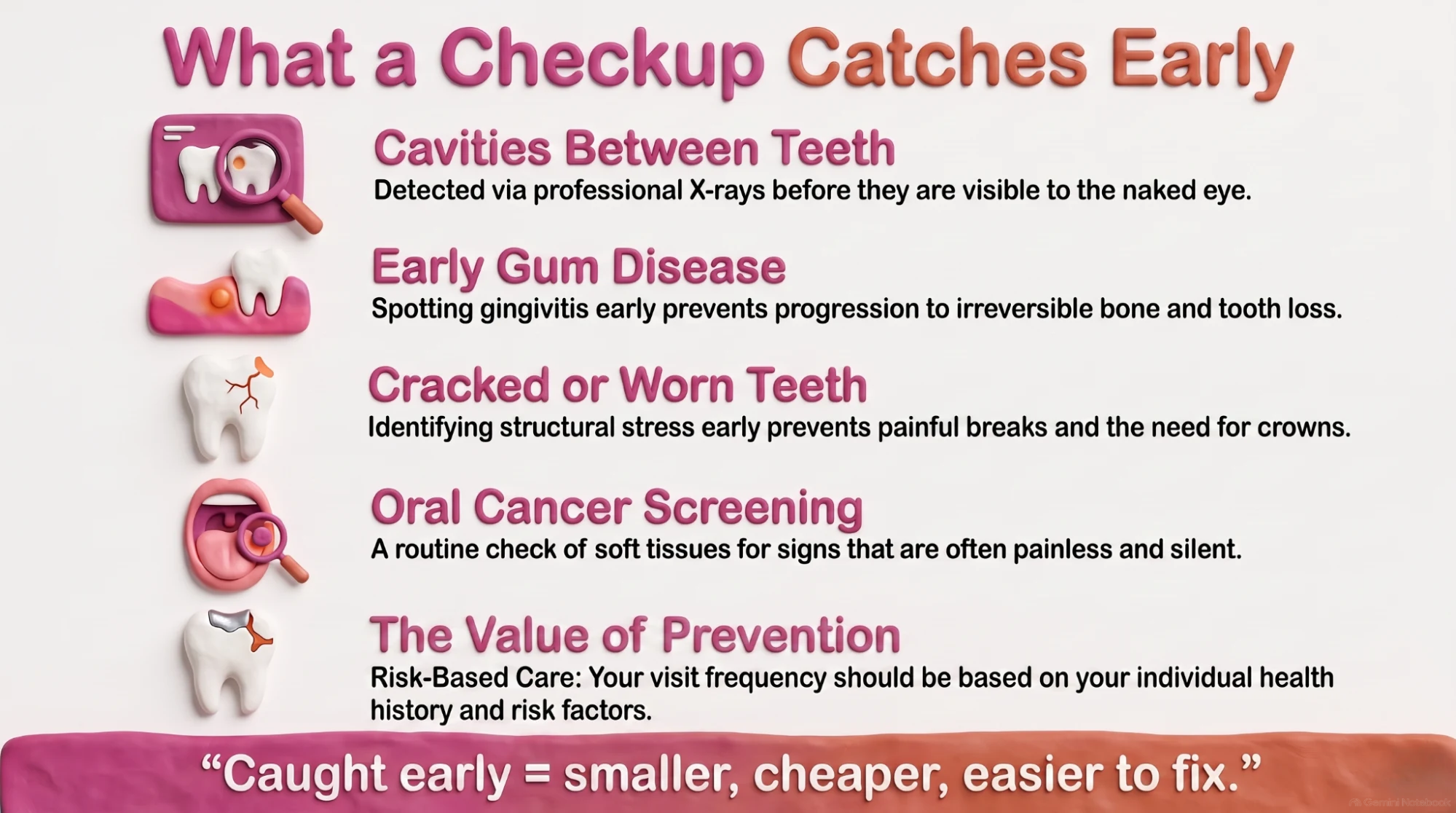
A routine visit does more than a polish. During checkups and X-rays at Hampton Family Dental, we remove plaque and tartar, check every tooth for decay, look at your gums for early disease, screen for oral cancer, and make sure old fillings and crowns are holding up. The Cleveland Clinic describes this early-detection role as the main value of regular visits — catching things while they're small, cheap, and painless to fix.
How often should you get dental X-rays?
X-rays follow the same risk-based logic as visits — there's no fixed calendar. Many healthy adults get a routine set every one to two years, while higher-risk patients may need them more often to catch decay between teeth or bone changes early. Your dentist orders X-rays based on what your mouth actually needs, not a rigid schedule, and modern digital X-rays use very low doses of radiation.
What if it's been years since your last visit?
If you've fallen out of the habit — no judgment, it's incredibly common — the best time to go is now. A tooth problem doesn't improve on its own while you wait, and coming in after a long gap simply means we start with a thorough look and a fresh plan. You won't be lectured. The goal is just to get you back on a schedule that fits your mouth, starting from wherever you are today.
Finding your rhythm in Southampton
The honest answer to “how often should I go” is: as often as your mouth needs, which is a conversation worth having with a dentist who knows you. Dr. Jeffrey Brenner and the team will look at your teeth and gums and recommend a schedule that fits — no more, no less. And if cost is what's kept you away, our membership plan covers your cleanings, exams, and X-rays for one simple yearly fee. Book a checkup and let's find your rhythm.
Due for a visit?
Book a checkup and we'll recommend the visit schedule that actually fits your mouth — no more, no less.