

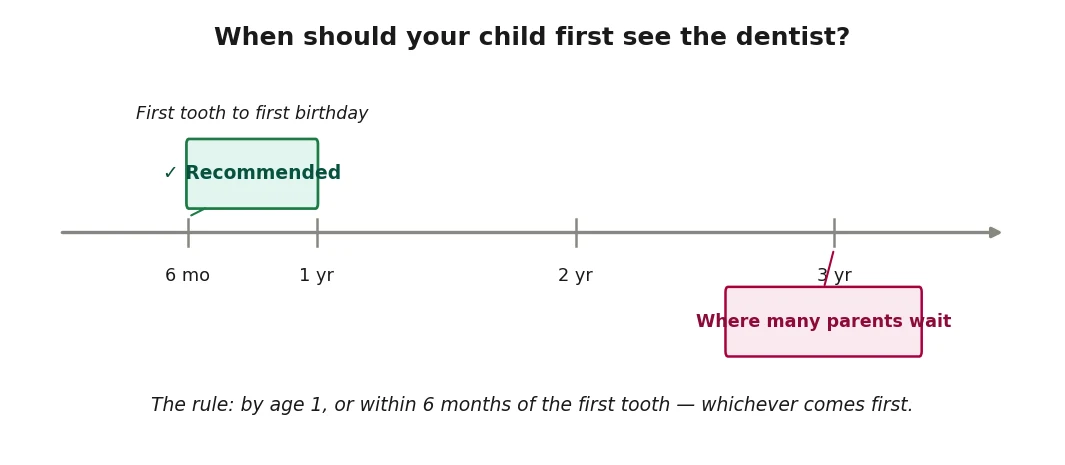
Your child should see a dentist by their first birthday, or within six months of their first tooth appearing — whichever comes first. It's earlier than many parents expect. The first visit is short and gentle, mostly about helping your child feel comfortable while the dentist checks their growing teeth and gums. At Hampton Family Dental in Southampton, PA, your whole family is welcome in one friendly office.
The short version
- Take your child for their first dental visit by age 1, or within six months of the first tooth.
- It's earlier than most parents think — many wait until age 3, which misses years of early prevention.
- The first visit is short, gentle, and mostly about comfort — often a quick lap exam for little ones.
- Baby teeth matter: they hold space for adult teeth and help with chewing and speech, so they need care.
- A little prep — positive words, a practice run, a morning appointment — makes the visit go smoothly.
When should your child first see the dentist?
Here's the fact that surprises most parents: your child should have their first dental visit by their first birthday, or within six months of that first little tooth poking through — whichever comes first. That guidance comes from the American Dental Association and the American Academy of Pediatric Dentistry. Many families wait until age three or four, but starting early is one of the simplest ways to set your child up for a healthy, fear-free relationship with the dentist. We love welcoming your family as new patients, little ones included.
Why baby teeth matter more than you'd think
It's easy to assume baby teeth don't need much fuss since they eventually fall out — but that's one of the most common myths in children's dentistry. Baby teeth hold the space for the adult teeth forming underneath, and they help your child chew, speak clearly, and smile with confidence. A cavity in a baby tooth can hurt just like any other, and decay can affect the permanent tooth waiting below. Caring for baby teeth from the start protects the adult smile that follows.
What actually happens at the first visit?
If you're picturing a scary procedure, relax — a first visit is short, gentle, and mostly about helping your child feel at ease. It usually takes 30 to 45 minutes. For babies and toddlers, the exam often happens right on your lap. The dentist gently checks how the teeth, gums, jaw, and bite are developing, may do a soft cleaning, and talks with you about everyday things — teething, thumb-sucking or the pacifier, bottle habits, brushing, and whether your child needs fluoride. If your little one wiggles or cries a bit, that's completely normal, and the team expects it. The main goal of the first visit is simply a happy introduction.
How to prepare your child (and yourself)
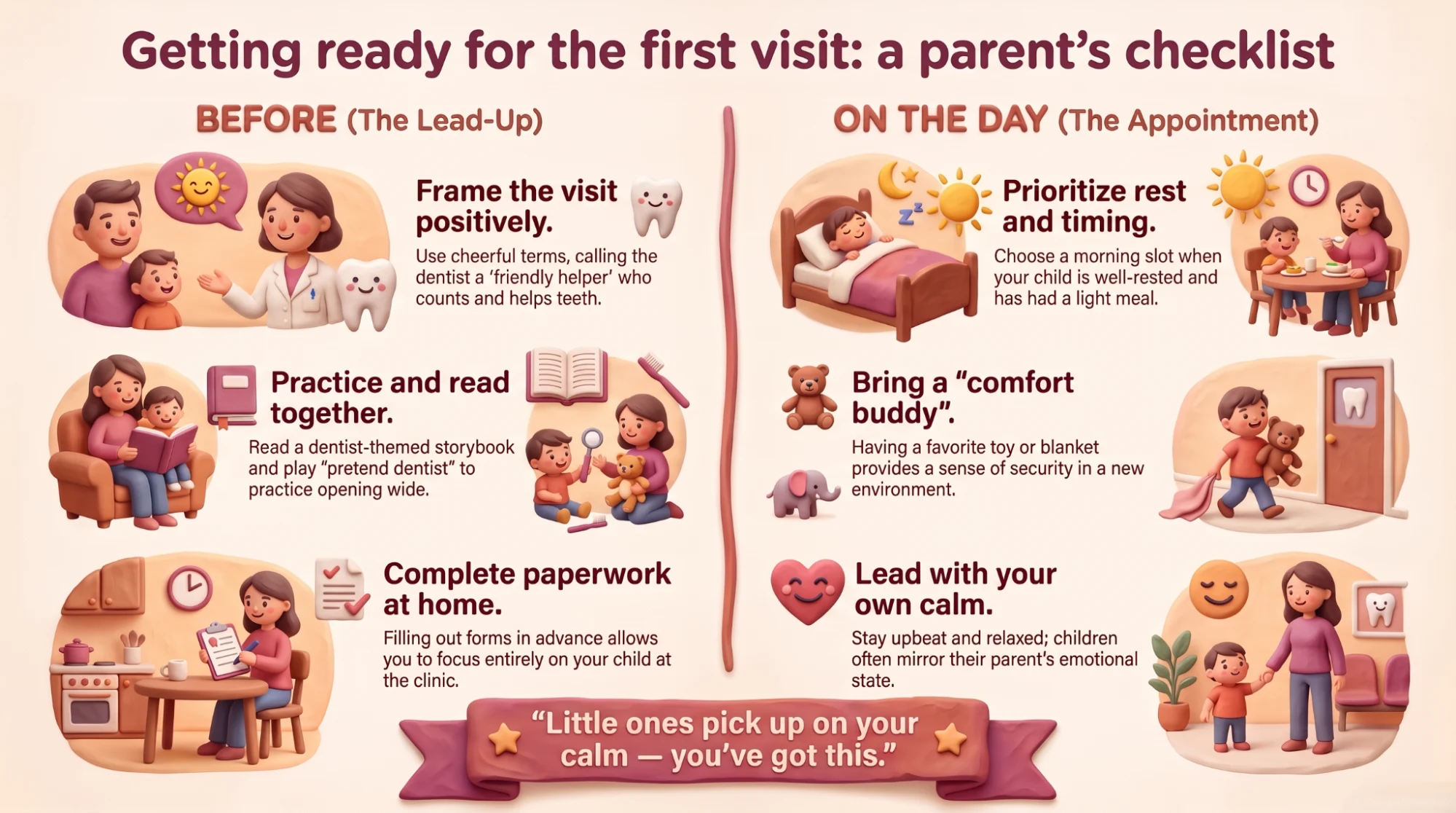
A little preparation goes a long way toward a smooth first visit — for your child and for you.
In the days before
- Talk about the visit in cheerful, simple terms — the dentist is a friendly helper who counts teeth and keeps smiles healthy.
- Read a children's book or watch a short show about going to the dentist; seeing a favorite character do it makes it feel normal.
- Play pretend: take turns being the dentist, practice opening wide, and “count” each other's teeth with a toy mirror.
- Steer clear of scary words like “hurt,” “shot,” or “drill” — even said reassuringly, they plant worries.
On the day
Pick a morning appointment when your child is rested and fresh, not near naptime. Offer a light meal and a toothbrush beforehand so they're not hungry, and save snacks for after. Bring a comfort item — a favorite toy or blanket — and any forms filled out ahead; you can ask us what to bring to the first visit. Most of all, stay calm and upbeat: children take their cues from you, so your relaxed smile is the best preparation of all.
Family dentist or pediatric dentist?
Parents often wonder whether their child needs a pediatric specialist. The reassuring answer from the Cleveland Clinic is that a general or family dentist can absolutely care for children — it comes down to your family's preference. A family practice has a lovely advantage: your child, you, and even the grandparents can all be seen in one office for family dental care, so visits are simpler and your child grows up with a familiar, trusted team. If your child has special healthcare needs or you'd prefer a specialist, we're glad to point you in the right direction.
It's never too late to start
If your child is already three, four, or older and hasn't been yet — please don't feel guilty. Life is busy, and the best time to start is simply now. A first visit at any age is a fresh, positive beginning, and getting into a rhythm of regular checkups from here forward is what matters most. Every healthy-smile journey starts with one appointment.
Your child's first visit in Southampton
We'd be honored to be part of your child's first dental memory. Dr. Jeffrey Brenner and the team have welcomed Bucks County families for more than 20 years, and we go out of our way to make little ones feel safe and even a bit excited. And because our membership plan keeps family care affordable with or without insurance, there's nothing standing between your child and a healthy start. Book your child's first visit whenever you're ready.
Ready for your child's first visit?
We'd love to meet your family. Call us or book online and we'll make your child's first visit a happy one.